AMA Vertical Tasting
Viña Almaviva
(2007-2023)
Before Christmas 2025, I received an email from Michel Friou, the winemaker at Almaviva. He proposed an online vertical tasting that would allow me to gain a structured understanding of how Almaviva evolves with age. An invitation like that, of course, was impossible to refuse, so I quickly made the arrangements.
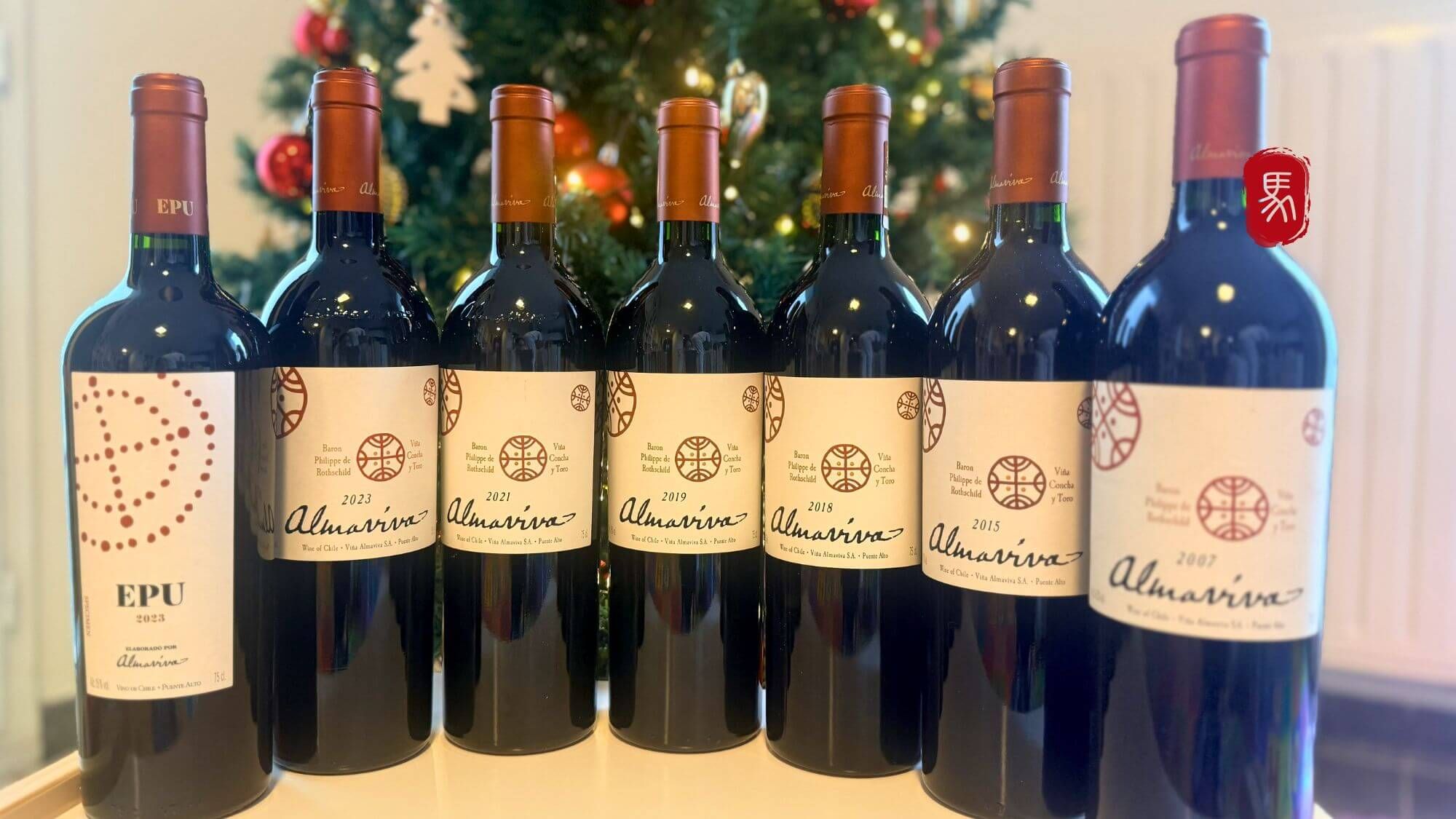
When the tasting list was unveiled, I realised that, in addition to the soon-to-be-released 2023 vintage, it included several of the most emblematic vintages in Almaviva’s history. The lineup was, to put it simply, impressive.
On the day of the tasting, we were putting up our Christmas tree at home. With the decorations all around, the red-and-white labels felt unexpectedly festive, made for a photo that felt unexpectedly symbolic, and quietly memorable.
Normally, I would begin by sharing my impressions from the vertical tasting itself. This time, though, I would like to start with the name Almaviva, as there is a small secret behind it that not everyone knows.
The name “Almaviva” comes from The Marriage of Figaro, where Count Almaviva plays a central role. The original work was written by the celebrated French playwright Pierre-Augustin Caron de Beaumarchais (1732–1799), and was later adapted by Mozart into one of the most famous operas of all time. The lettering on Almaviva’s label is, in fact, taken directly from Beaumarchais’ own handwriting.
What made this small secret even more astonishing to me was what came next. I later learned that Julien de Beaumarchais de Rothschild, now one of the co-owners of the Baron Philippe de Rothschild group, comes directly from the Beaumarchais family — in other words, he is a descendant of the author of The Marriage of Figaro nearly three hundred years later.
Once I understood this extraordinary connection and looked again at the Almaviva label, I could not help but think: how marvellous the Chinese name “活灵魂 (Living Soul)” truly is!

AMA SNAPSHOT OF ALMAVIVA
Having shared this small secret, let us now return to the essentials. Before tasting Almaviva, there are a few key points well worth keeping in mind:
1. “Sweetness” is a constant theme
Across vintages, Almaviva consistently shows generous fruit and a clearly defined sense of sweetness, while tannins remain smooth and finely textured. This balance forms one of the estate’s most reliable through-lines.
2. Herbal notes are not dominant
The herbal character often associated with Chilean wines is not a defining feature of Almaviva. Even in vintages with a higher proportion of Carménère, such notes rarely take the lead.
3. Salinity becomes evident from 2018 onward
Beginning with the 2018 vintage, a distinct saline note starts to emerge. It develops in step with the fruit and structural elements, becoming one of Almaviva’s most recognisable recent signatures.
4. The key vintage for understanding Almaviva: 2019
If I had to choose a single vintage to understand Almaviva as a whole, it would be 2019, without hesitation. I often think of it as the “all-round Almaviva.”
5. Black truffle may appear with age
In the 2007 vintage, a rare black truffle note once emerged. Based on its current trajectory, the 2018 vintage may well evolve in a similar direction over time.
6. Vintage variation is pronounced
Rainfall is one of the most critical factors influencing Almaviva’s performance. From my tastings, the wine tends to show greater brand definition in hot, dry years than in milder ones.
Vintages such as 2022, 2020, and 2015 display remarkable energy, while the milder and drier 2021 offers a gentler, more approachable profile, albeit with slightly less of the tension characteristic of Chilean Cabernet-based blends.
7. Decanting is essential
When first opened, the alcohol can feel distinctly warm, even a little overwhelming. With around an hour of decanting, however, it gradually integrates with the fruit and structure, settling into a profile that is rich and expressive, without feeling heavy
A Chance Encounter Between Two Families, and a Thirty-Year Partnership
Almaviva was born in the 1990s, carrying the era’s sense of directness and purity.
At Vinexpo, then the largest wine exhibition in the world, two giants from opposite hemispheres happened to cross paths: Baroness Philippine de Rothschild and Concha y Toro. From their very first conversations, the connection was immediate. It did not take long for a shared direction to emerge: to create a true Grand Vin de Cabernet, rooted in Chilean terroir.
In the end, a site in Maipo Valley, close to Santiago, in the Puente Alto area, was chosen, and with that decision, the journey of Almaviva quietly began.

The first vintage arrived in 1996, and Almaviva soon became the first non-Bordeaux wine to be distributed through La Place de Bordeaux, opening a new chapter in which top estates from around the world would enter the Bordeaux distribution system.
In 2000–2001, the second label, Epu, was introduced. Initially sold only in Chile, it entered the Brazilian market in 2006. It was not until 2019, once the estate felt Epu had achieved a sufficiently distinct identity, that it was released globally via La Place de Bordeaux.
Even the label itself tells a story of meaningful convergence. The name appears in Beaumarchais’ handwriting, while the imagery pays homage to ancient Chilean civilisation, with the rising and setting sun symbolising earth and cosmos. Two traditions stand side by side, neither dominating the other, yet together forming something new.
Why Puente Alto?
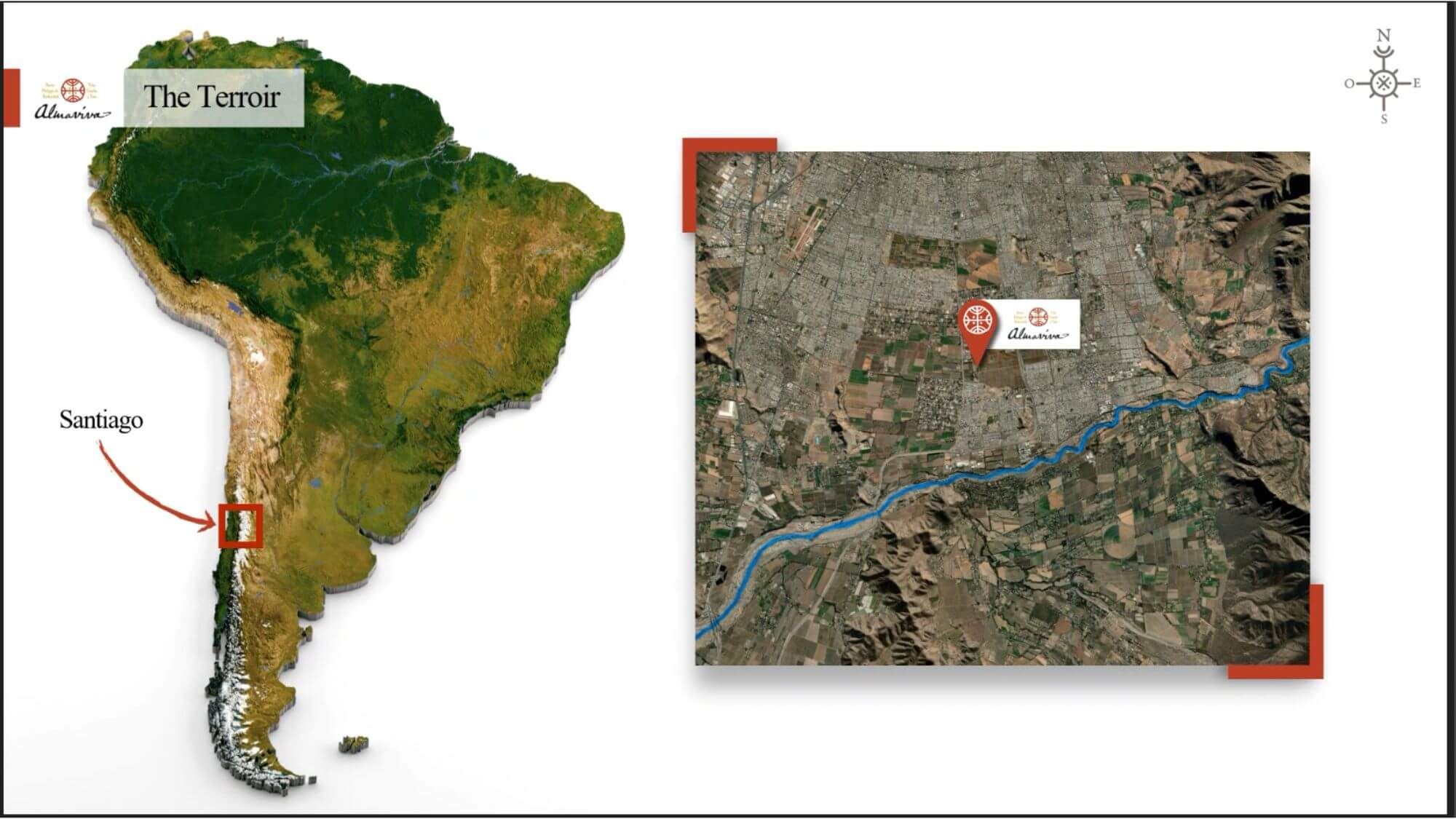
In my conversations with Michel Friou, I learned that Puente Alto sits at an elevation of roughly 630–650 metres, making it one of the coolest microclimates within Maipo Valley.
The climate is semi-arid Mediterranean, with average annual rainfall typically below 300 mm, concentrated largely in winter, making irrigation almost indispensable. That said, phenomena such as El Niño and La Niña can bring dramatic extremes, as seen in 1998 with 730 mm of rain, or in 2020 with just 69 mm.
What truly sets Almaviva apart, however, is the cooling influence of breezes from the Andes, combined with cold air masses linked to the Humboldt Current.
This results in pronounced day–night temperature differences during summer: warm days promote sugar and phenolic development, while cool nights preserve acidity and sharpen aromatic clarity.
Rainfall during harvest is minimal, allowing the team to tailor picking decisions precisely to each variety and parcel, and to extend the harvest window with confidence.In some years, Michel told me, harvest can stretch over six to seven weeks.
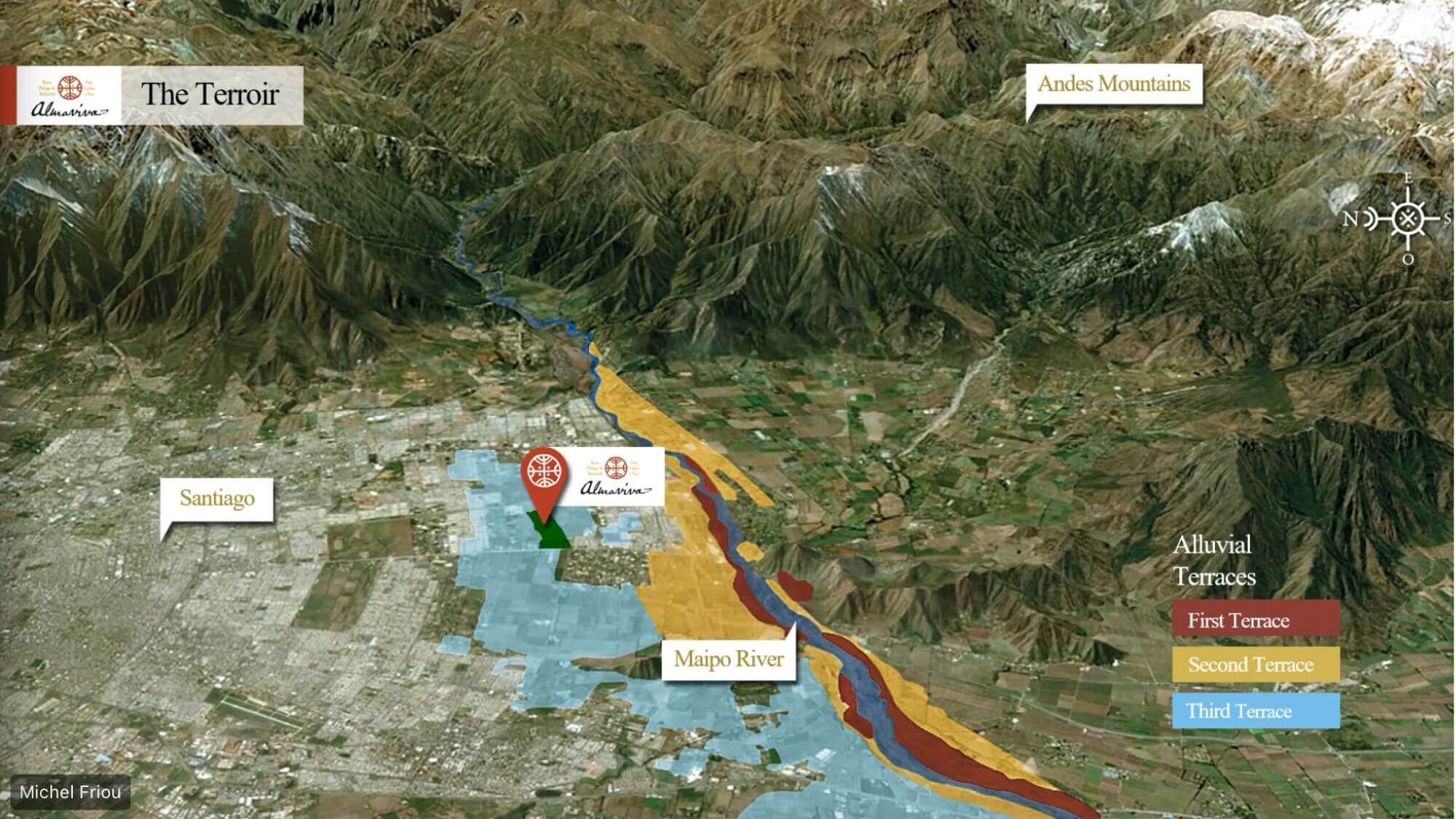
From a soil perspective, Puente Alto is dominated by alluvial formations, with a high proportion of gravel and excellent drainage, clearly layered in structure. The topsoil often contains loam and clay, while deeper layers consist of sandy loam, gravel, and stones.
The estate further divides the vineyard into three distinct terraces, each with its own ripening rhythm and structural profile.
Terrace 1 lies closest to the Maipo River.
Terrace 2 is sandier, with faster ripening but slightly coarser tannins.
Terrace 3 rich in gravel and containing around 8-10% clay, is the recognised core of the estate and consistently delivers the highest quality.
Almaviva’s Lifeline: Old Vines and Franc de Pied
One of Almaviva’s most valuable assets lies in its old-vine Cabernet Sauvignon, some of which dates back to 1978. These vines produce very small berries and bunches, resulting in greater flavour concentration and tannins that are both finer and more compact.
Around half of the vineyard is planted with “Franc de pied”, or ungrafted vines. These tend to show greater drought resistance, lower pH levels, and a softer, more balanced tannin profile. From 2001 onward, higher-density planting inspired by Bordeaux was introduced in selected parcels, and since 2005, “intra-parcelle” harvesting has further refined control over ripening at a very granular level.
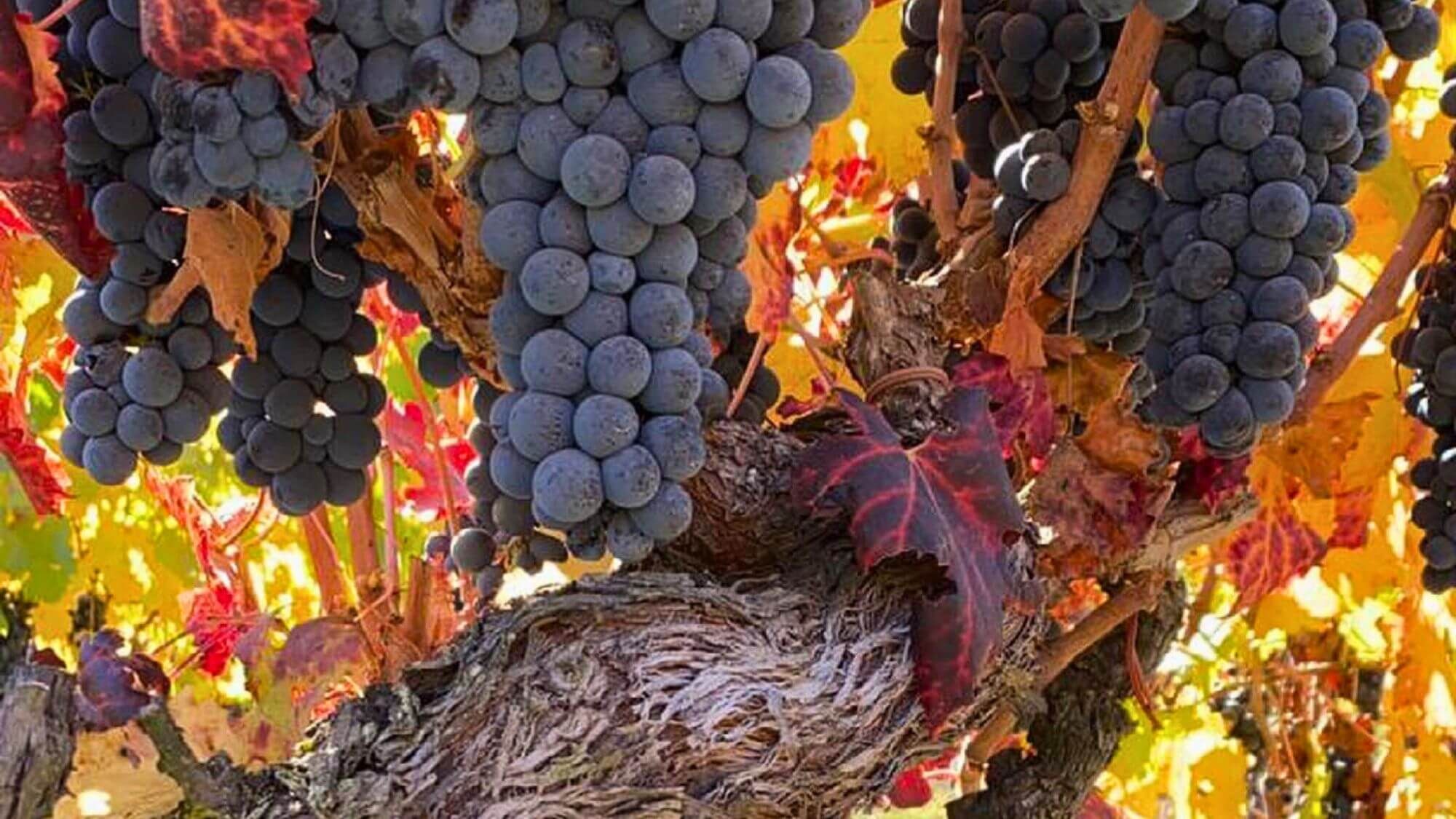
Could Carménère Become a Future Trump Card?
During the tasting, I was struck by how rarely Almaviva shows the familiar “overripe yet green” paradox often associated with Chilean wines, even in vintages with a relatively high proportion of Carménère.
Curious about this, I asked Michel Friou for a deeper explanation, and his response struck me as particularly thought-provoking.Michel explained that his long-term observation suggests Carménère actually performs better in cooler years with longer growing seasons. Under such conditions, green flavours diminish, colour extraction improves, and ripeness becomes more harmonious.
In contrast, in hot, dry years, water stress can halt vine growth, increasing the risk of greenness. As long as Carménère is not pushed into excessively dry conditions, it may reveal even greater potential in the future.
With continued progress in vineyard management, we may well see more Carménère of genuine interest and substance at Almaviva, and across Chile more broadly.
Looking Ahead
In 2026, Almaviva will mark its thirtieth anniversary.
Looking back, it becomes clear that its reputation was not built on a single defining moment, but through continuous trial, adjustment, and refinement across successive vintages.
To be honest, I was not an immediate admirer of Almaviva myself. Yet the estate’s strong performances in recent years have certainly won me over.
What has always mattered most, in my view, is the clarity of the original ambition: to produce a truly “GREAT” Bordeaux blend on Chilean terroir.
Perfection may still lie just out of reach, but as long as that goal remains unchanged, Almaviva will continue to move ever closer to it, and in doing so, offer us many more memorable tasting experiences along the way.