
AMA Tasting Report-Bordeaux 2025 En Primeur
AMA En Primeur Selection – “Blooming Lotus Selection” 2025

Bordeaux 2025 En Primeur
“A Sun-Kissed Crystal”
- Part I: Overall Impression
- Part II: Analyse Tool: The 5+1 Essentials of a Great Vintage
- Part III: The Characteristics of Bordeaux 2025 En Primeur Wines
- Part IV: Purchasing Tips
- Part V: Important Considerations after bottling
- Part VI: A Closing Reflection
- Part VII: AMA En Primeur Selection – “Blooming Lotus Selection” 2025
<Part I>
Overall Impression
Years from now, when people look back on Bordeaux’s 2025 vintage, what words will they choose to describe its beauty, and what kind of praise will they offer to affirm its singular character? I do not know. Yet from my own experience, this hot, dry, and early-ripening year delivered a sense of astonishment I had not anticipated, along with a pure delight that reached straight to the heart.
To be honest, before the decisive rainfall at the end of August that ultimately reshaped the vintage, I had been increasingly concerned. Temperatures hovered around 35°C for days on end, at one point even surging to 41.6°C. I worried that the grapes would lose their sense of balance and elegance, that alcohol levels might run out of control, and that the fruit would tip into overripeness, slipping into a heavy, jammy profile.
Yet when I returned to Bordeaux from China in September and tasted the grapes for the first time, that weight on my chest finally lifted. After finishing my assessment of the single-varietal base wines, I was already smiling with quiet satisfaction, and once I had systematically tasted through the full range of En Primeur samples, the feeling could only be described as a moment of real excitement.
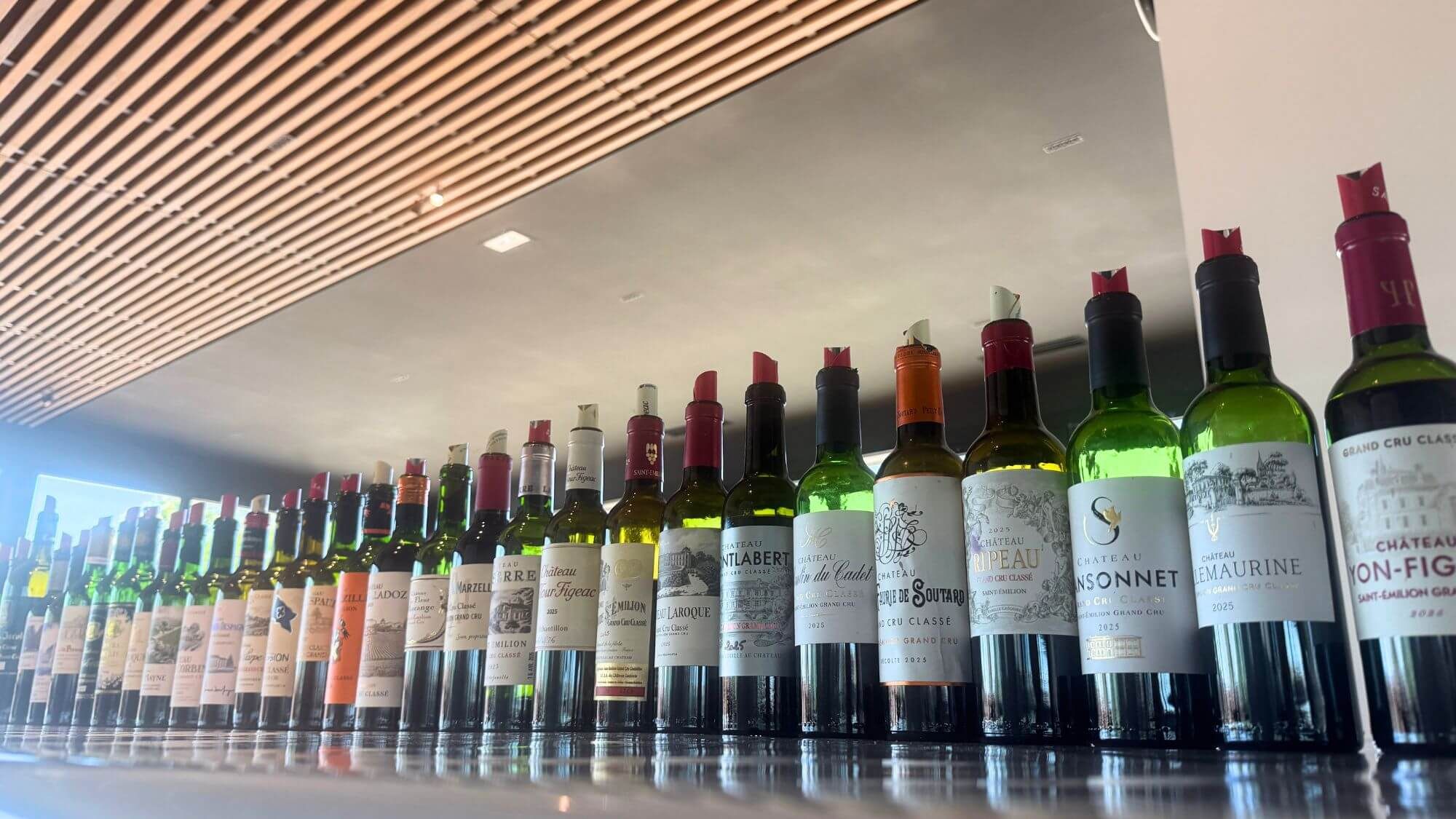
It is no exaggeration to say that this is the most “effortless” En Primeur vintage I have tasted in the past decade, and also the most immediately approachable. Its aromatics are direct and unreserved, revealing themselves without hesitation. Floral and fruit notes emerge like a radiant beam of light, layered yet clear, unfolding in the glass with remarkable clarity.
On the palate, while the wines possess real concentration and structure, they remain transparent and vibrant, like a breeze moving through a pine forest, carrying no sense of heaviness or pressure from start to finish, except for a few estates where extraction was pushed too far. The acidity and pH levels are nothing short of astonishing; that luminous freshness alone is enough to completely redefine expectations of what a traditionally “hot” vintage can be.
What fascinates me even more is how, in such an extreme dry and hot year, the energy of fire and the lightness of wind have been fused with such seamless precision. The vintage carries the density and concentration of 2022, the crystalline aromatic purity of 2016, and the openness and charm of 2019. Faced with a 2025 of this caliber, I can only raise my hat in respect.
The only regret lies in the low yields. Many estates produced less than 30 hl/ha, with quite a number falling below 20 hl/ha. During my tastings, I often came across proprietors who seemed quietly resigned to the low yields.
At such moments, I would often comfort with the Eastern philosophy of “letting go in order to gain”. In most cases, nature has already carried out the most exacting selection on our behalf. Those grapes unable to withstand the pressures of the growing season are gradually left behind, while those that remain are purer, and possess a greater sense of inner strength.
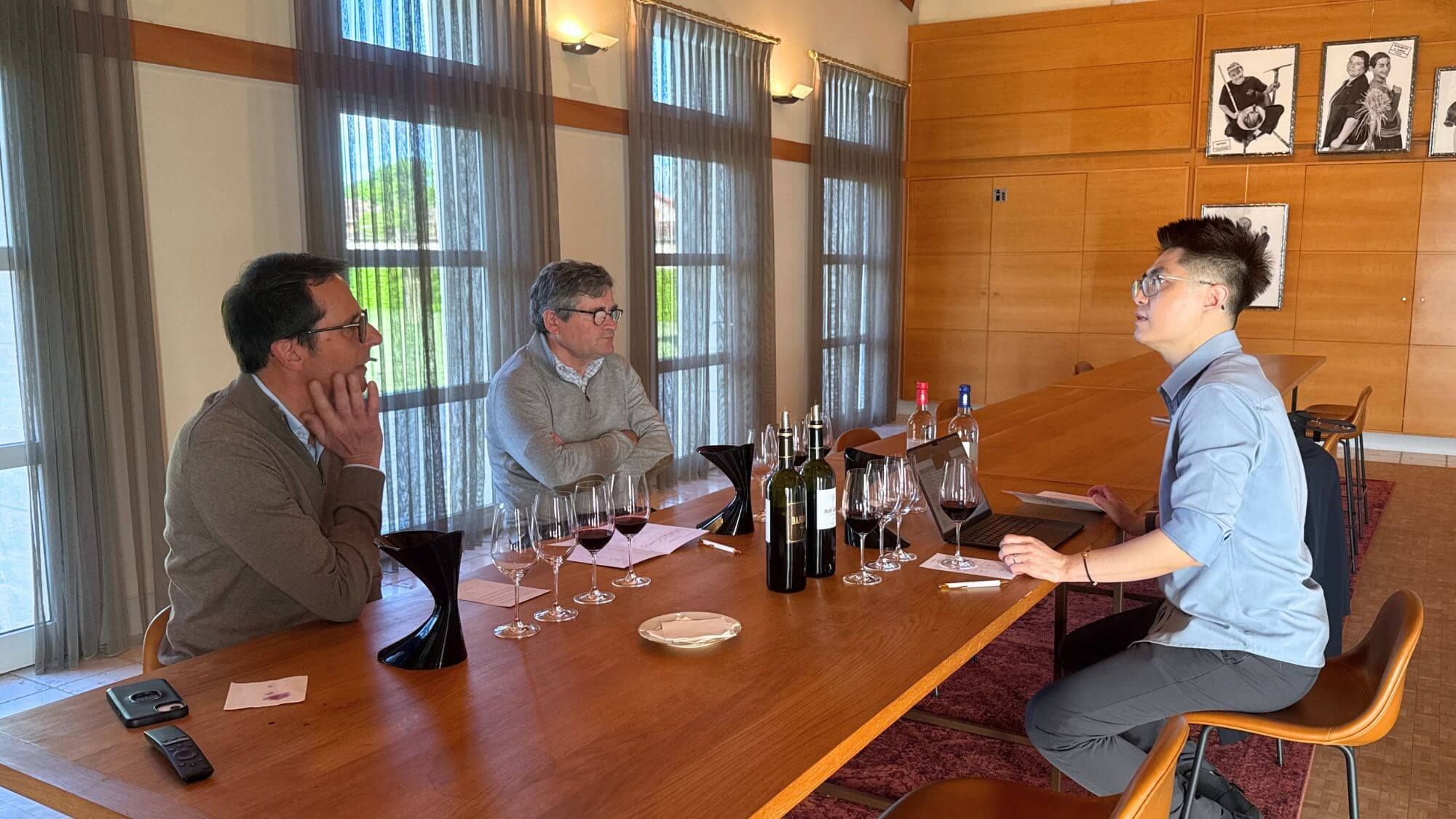
This year’s En Primeur tastings ran from April 2 to April 28. During that time, I tasted more than 1,000 wines, of which over 460 wines scored 90 points or above have been published on the website. Aside from translation work, I wrote approximately 100,000 words in one month.
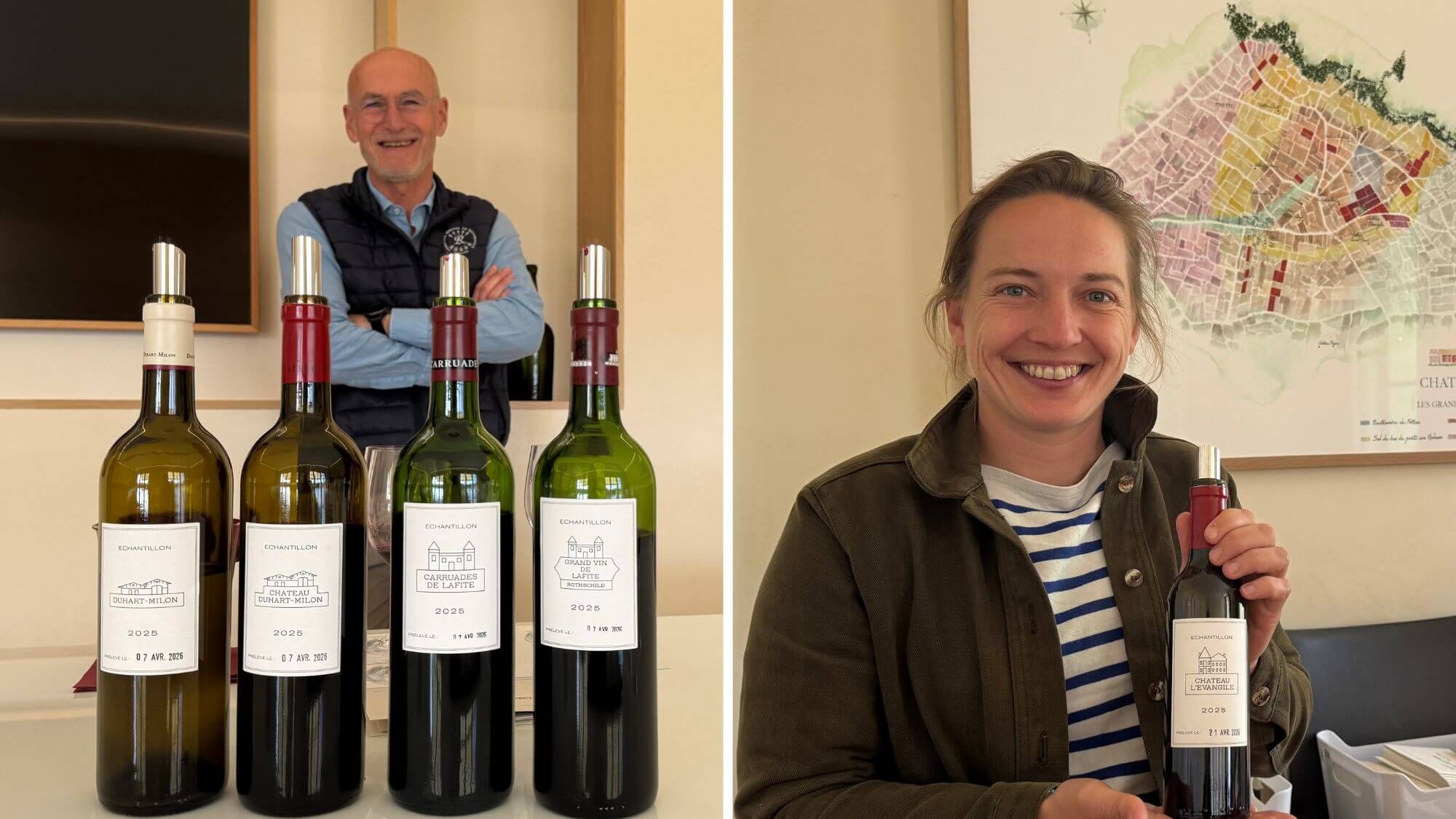
Here, I would like to extend my sincere thanks to my wife, Phydiasse, who took on an immense workload in translating and reviewing the tasting notes. The entirety of our work from this past month is now online, and you are warmly invite to visit www.alexandrema.com.
During the tastings, the two questions I was asked most frequently happen to be the very keys to understanding the 2025 vintage:
-Why, in such a dry and hot year, are alcohol levels relatively moderate?
-And how has the acidity been preserved so beautifully?
<Part II>
Analyse Tool: The 5+1 Essentials of a Great Vintage
(1) Flowering and Fruit Set Conditions
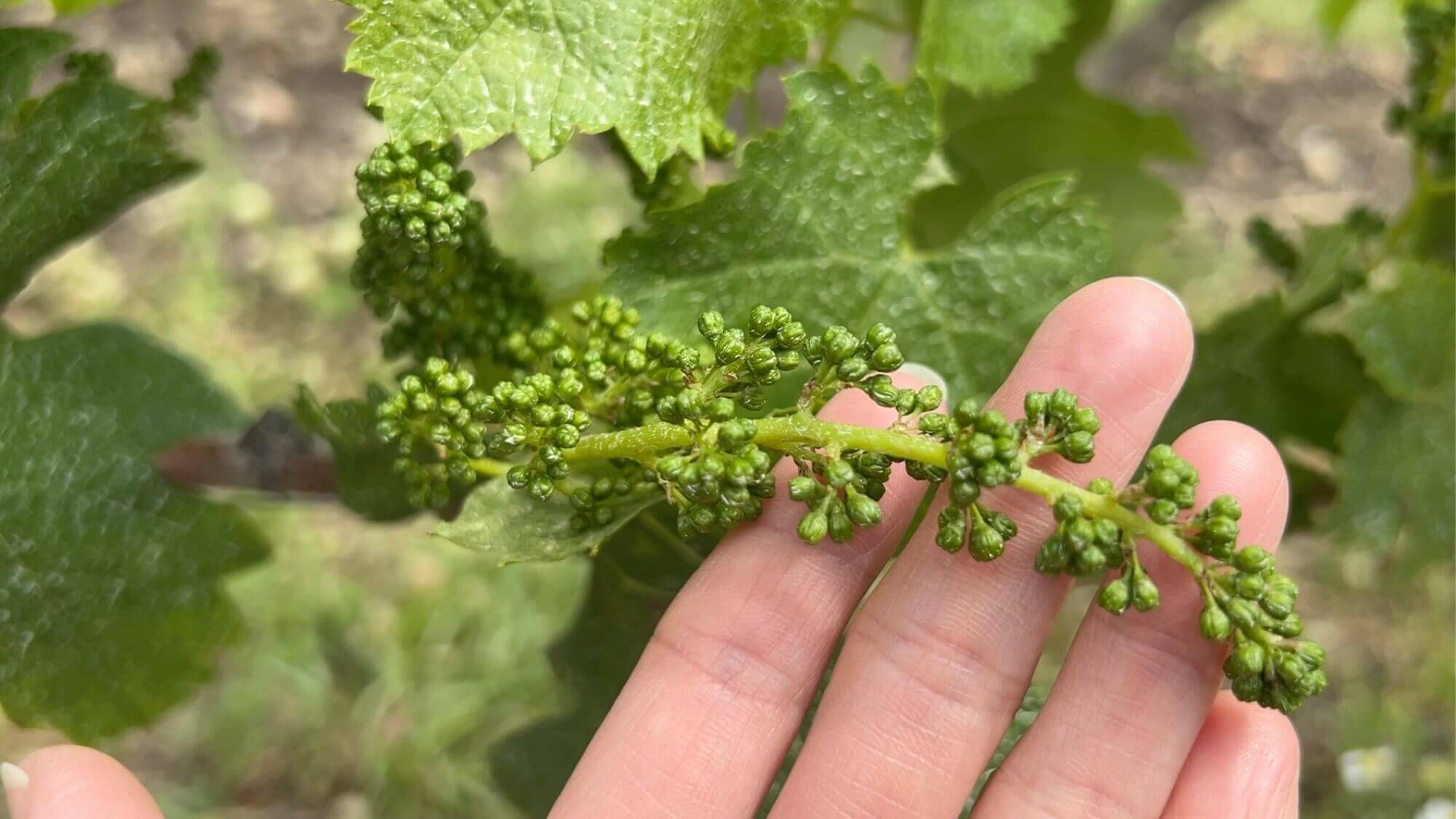
If one were to describe the 2025 flowering season in a few words, it was brief, smooth, and remarkably efficient. The first blooms appeared toward the end of May, roughly ten days earlier than usual. Conditions throughout the period were ideal, with gentle temperatures and plenty of sunshine. Flowering progressed evenly, without interruption.
As a result, berry development was highly uniform, and the ripening cycle that followed showed the same consistency.
(2) Berry Condiitons After Fruit Set
In a typical year, a smooth flowering period would naturally lead to a healthy number of berries. Yet 2025 turned out to be quite different. After fruit set, not only were the bunches fewer than expected, but the berries themselves were also notably small.
Let’s start with yield. The cool, wet conditions of 2024 had already influenced the vines’ behavior going into early 2025, encouraging a more restrained growth cycle. The number of inflorescences was reduced from the outset, which in turn limited the number of berries per bunch. In some regions, yields for white varieties dropped by as much as 50%.
As for berry size, the persistently dry conditions following fruit set played a decisive role. The lack of water directly restricted berry expansion. In many ways, the style of the vintage was already taking shape at this stage: from the moment of fruit set, 2025 was set on a path defined by small berries and high concentration.
(3) Weather Conditions Around Véraison
The weather around veraison can be summed up quite simply: persistently dry and intensely hot.
Veraison was largely completed around July 26, with the process lasting roughly ten days. It moved quickly and, more importantly, with remarkable uniformity, finishing about 7–10 days earlier than in a typical year.
Early July brought relatively moderate conditions, which were beneficial for anthocyanin development. However, from mid-to-late June through the end of July and into August, heat and drought clearly dominated the growing season.
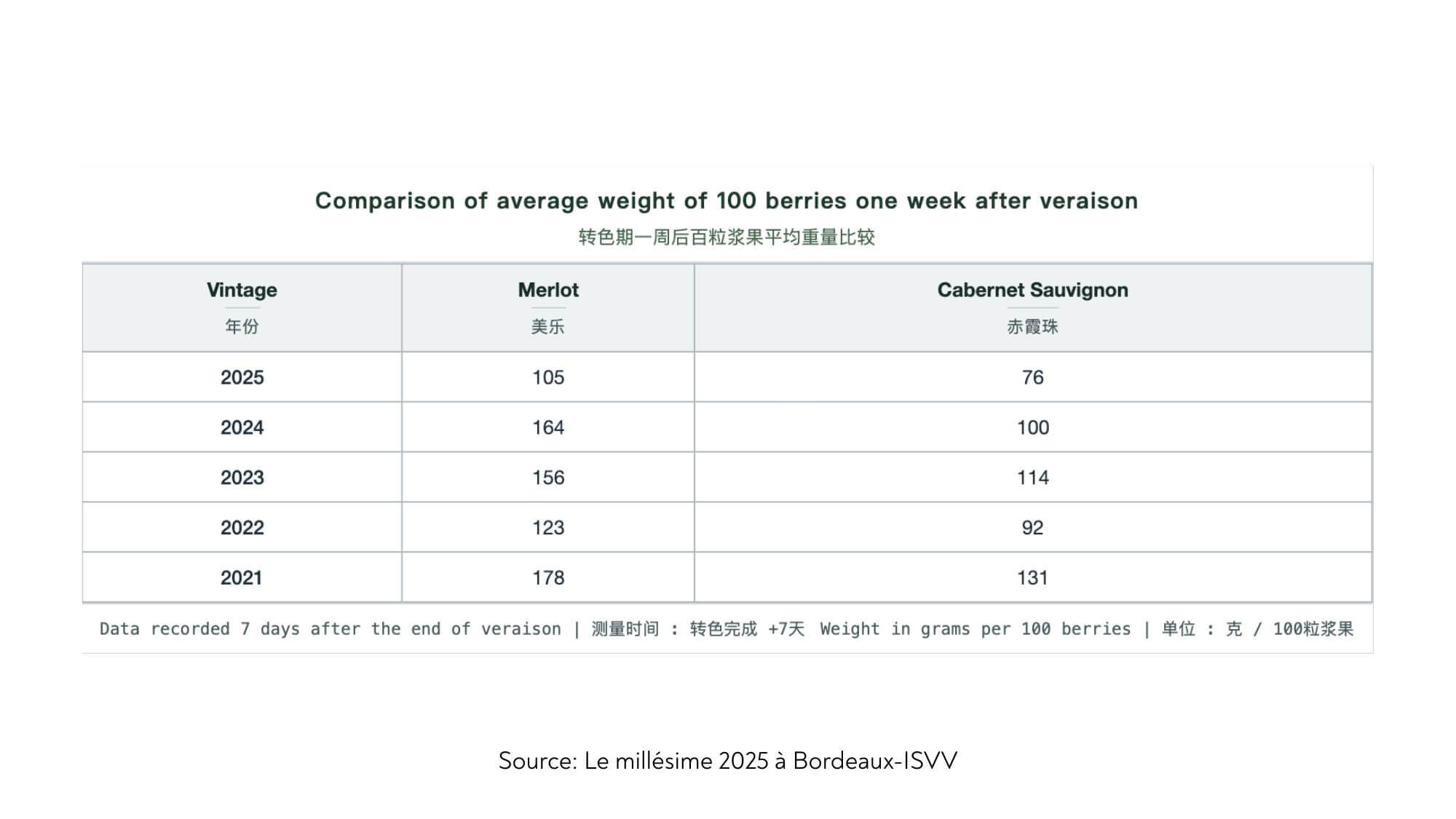
Under such conditions, the already small berries were further constrained, showing little to no additional
(4) Ripening Conditions
The month of August, following veraison, proved to be a particularly trying period for growers. For most of the month, conditions were dominated by sustained heat, with temperatures frequently exceeding 35°C and peaking at a record-breaking 41.6°C.
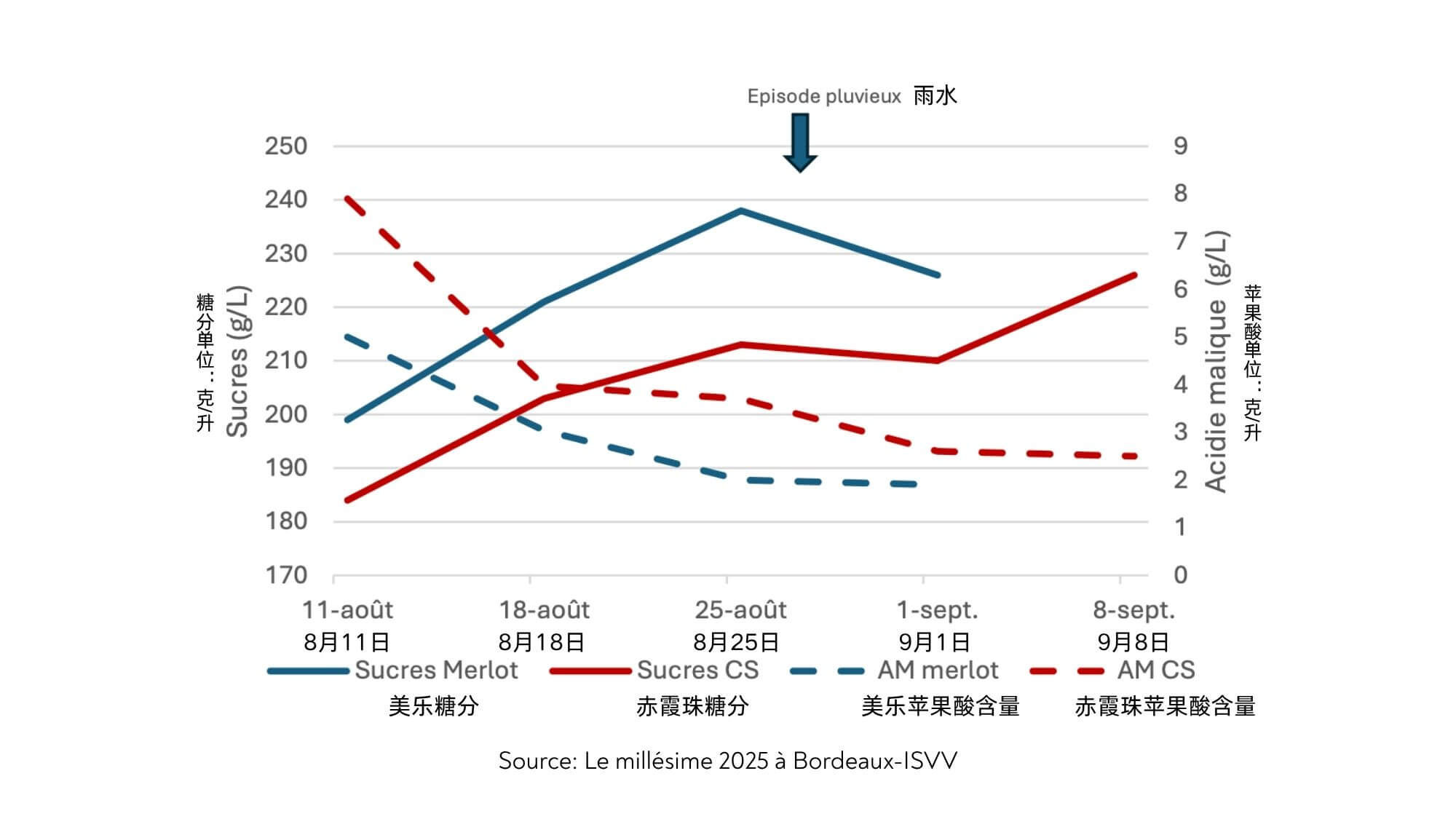
One saving grace, however, was the significant diurnal range, which at times reached close to 20°C and played a crucial role in preserving acidity. Even so, during this period, acidity declined rapidly while sugar levels rose at an equally fast pace. In well-drained soils, some vines even began to shut down, with growth coming to a halt and leaves turning yellow.
By late August, a new challenge had clearly emerged. Growers widely observed that sugar levels had already climbed very high, with potential alcohol reaching around 12%, yet tannins had not fully ripened. This created a difficult decision: harvesting early would result in dry, astringent tannins, while waiting longer risked a sharp rise in alcohol levels and the development of overripe aromas.
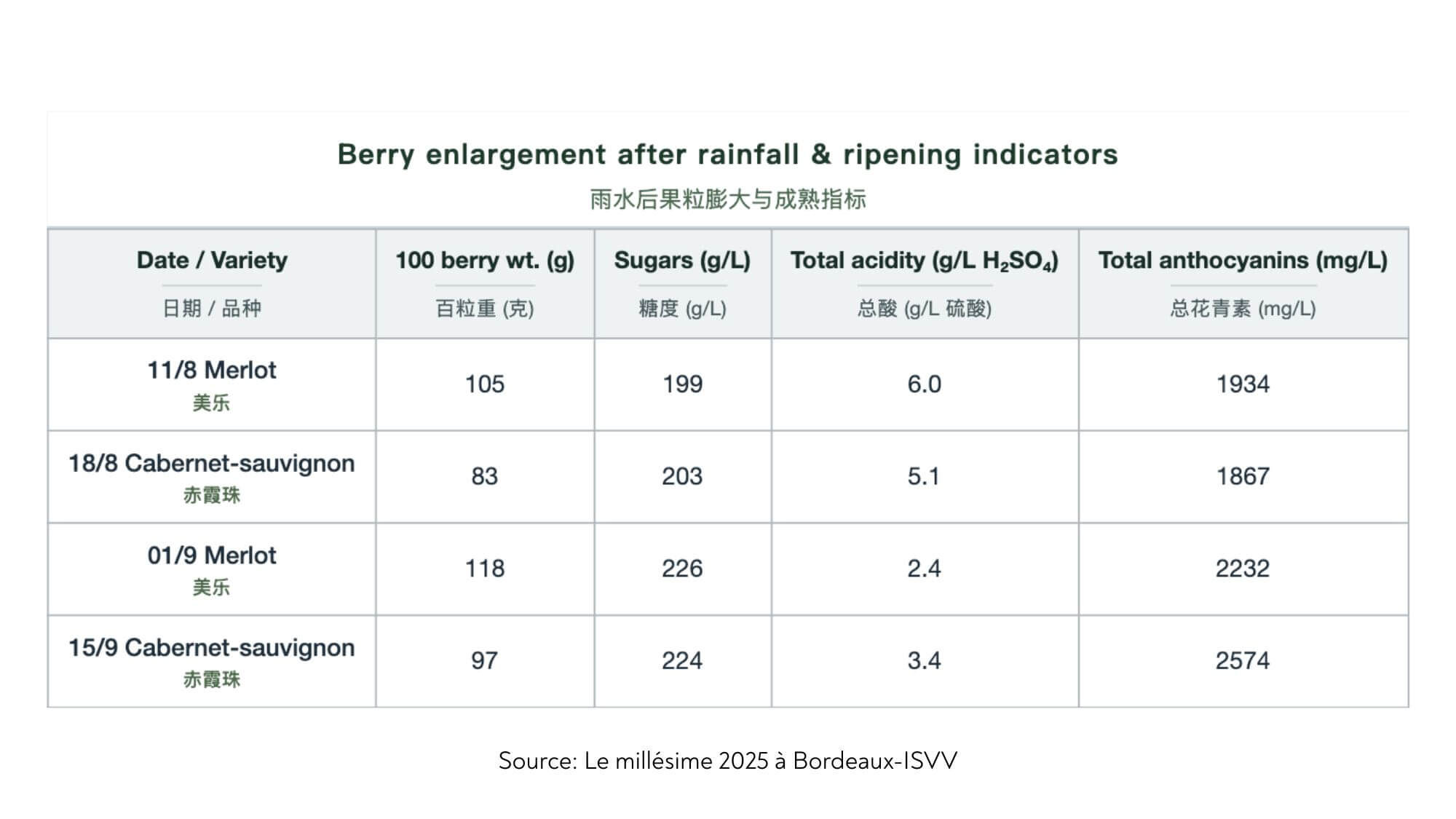
It was at this critical moment that the turning point of the 2025 vintage arrived. Rainfall on August 20, followed by further showers between August 28 and 31, brought a total of 50–80 mm of precipitation. The long-parched berries rapidly absorbed water, leading to an increase in weight. For Cabernet Sauvignon and Merlot, the weight per 100 berries rose from 83 g and 105 g in mid-August to 97 g and 118 g in September, respectively.
Although the berries ultimately remained on the smaller side, the excessive sugar concentration was effectively moderated. The previously tight and compressed fruit profile began to relax and open up. Most importantly, the polyphenols, which had been held back under stress, were finally able to improve, allowing tannin ripening to fully engage.
Seen in this light, the rainfall at the end of August was nothing short of a blessing for the 2025 vintage.
(5) Weather Conditions During Harvest
Following the late-August rains, most estates began harvesting. Conditions during the harvest period were mild and relatively dry, offering an ideal environment for picking. With ripening progressing evenly, the harvest window was equally favourable and well-defined. Even for larger estates, most were able to complete the harvest within a little over ten days.
Looking at the fruit itself, several key characteristics stand out: high concentration, precise and vibrant fruit expression, and a bright acidity. This interplay between structure and freshness gives winemakers all the essential elements needed to make wines of real depth and energy.
+1: Extreme Weather Events
Overall, the 2025 vintage was not affected by any major climatic hazards. The only exception was a few parcels that came under significant water stress due to the prolonged heat and drought.
<Part III>
The Characteristics of Bordeaux 2025 En Primeur Wines
Red Wines
1. Grand Structure, with a Rich, Layered Texture
I have always emphasized that great red wines are built on great tannins, and that great tannins come from fully ripe phenolic compounds. In 2025, the small berries and the high level of tannin ripeness not only give the wines a rich texture, but also build a structure that is both profound and firmly grounded.
The tannins themselves show a fascinating range of textures and expressions.
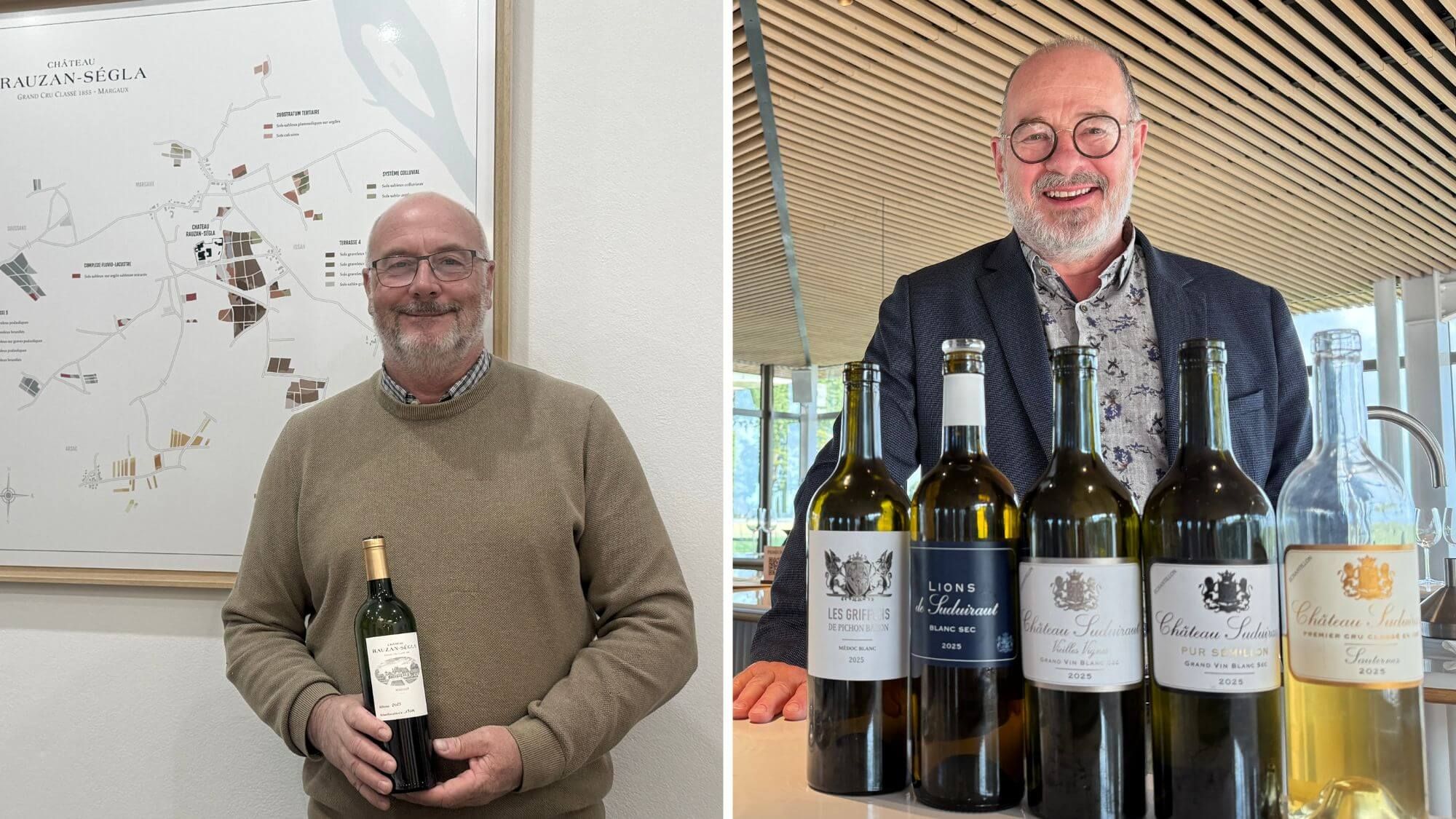
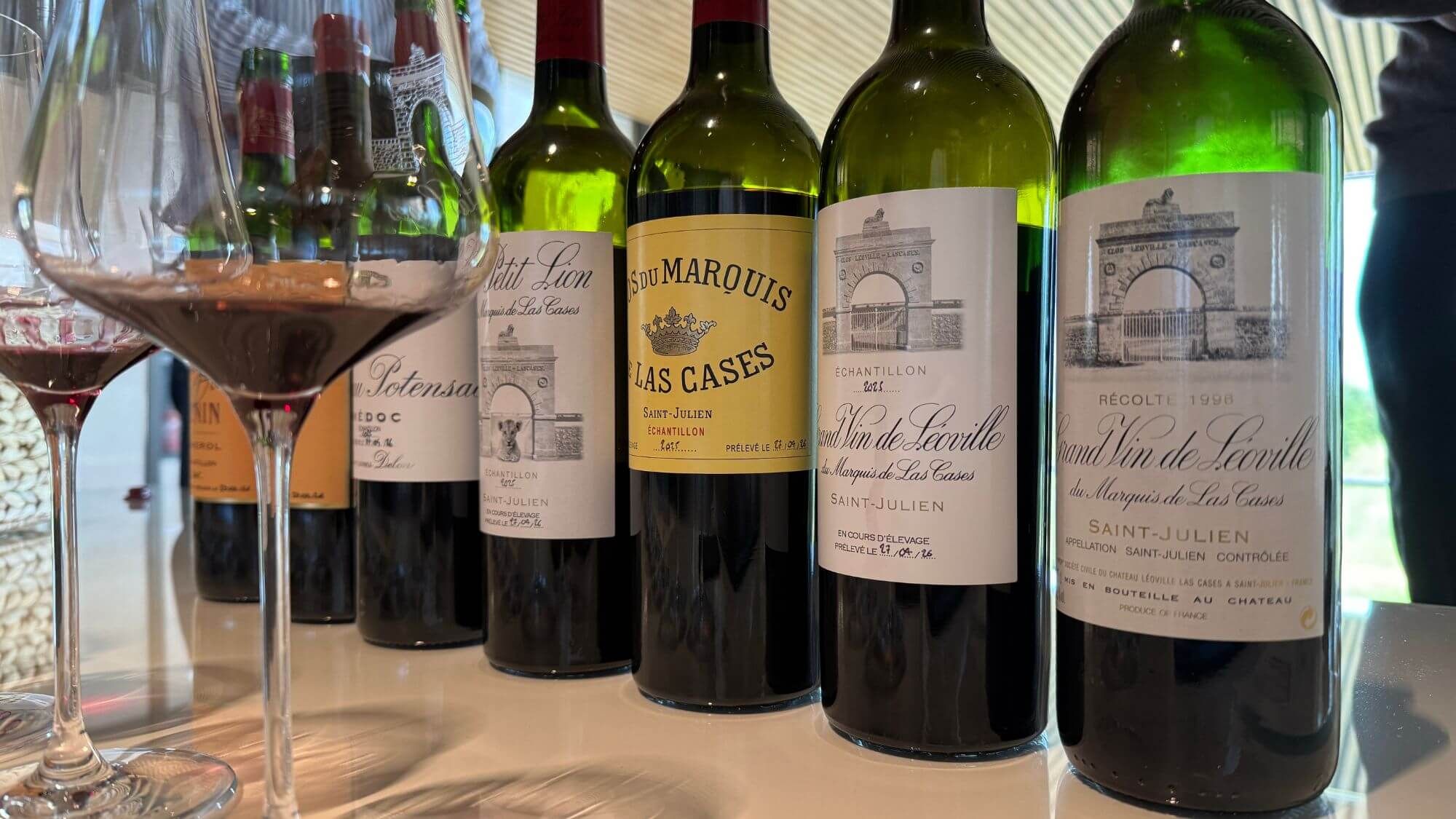
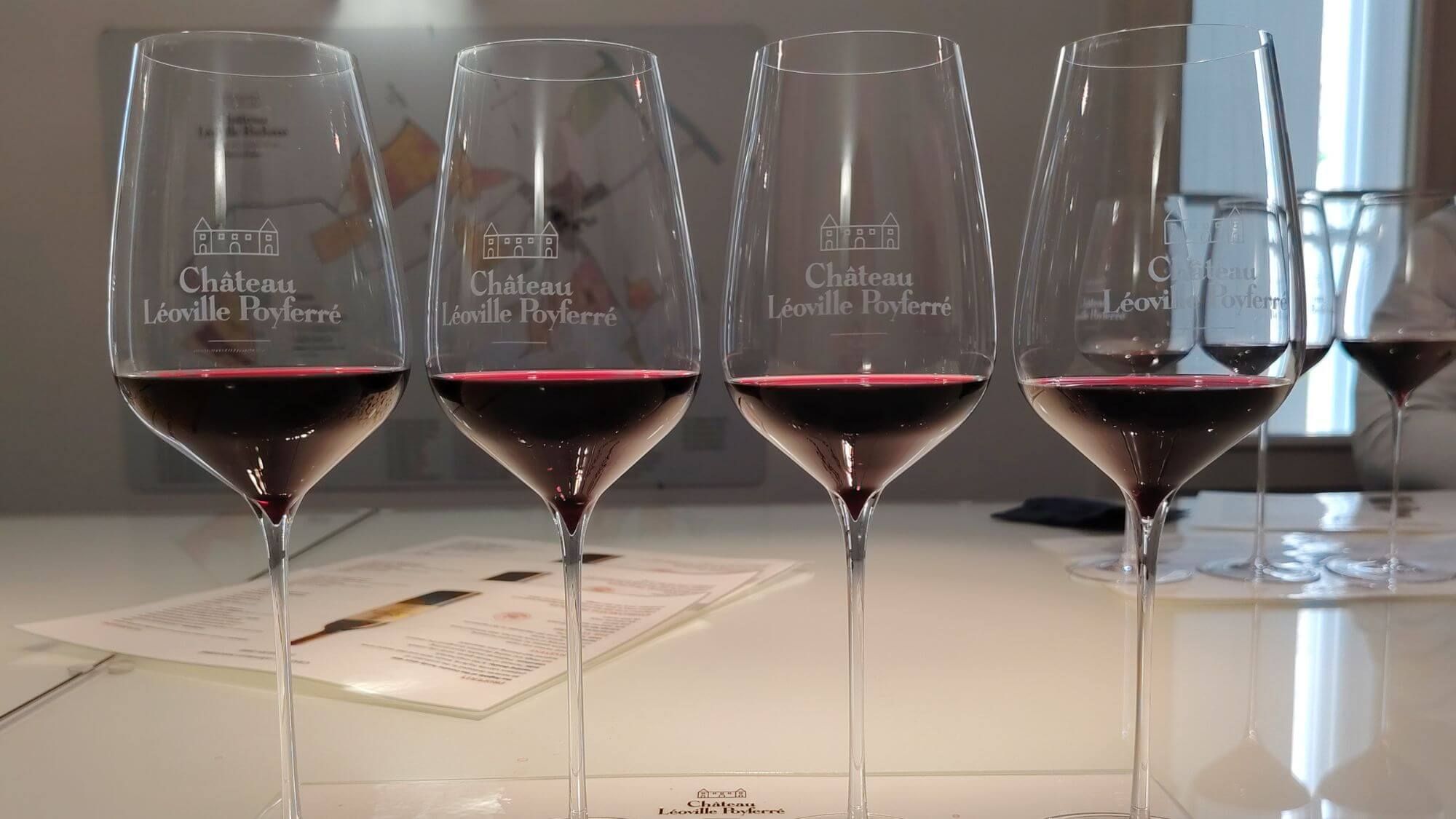
Some are as fine as powder, like a light dusting of almond flour gently coating the palate, as in Château Léoville Poyferré. Others are supple and smooth, melting on the palate like a piece of velvety cake, as in Château Rauzan-Ségla. Still others take on the form of a slightly cool, molten-centred chocolate, quietly flowing across the palate, as in Château Carbonnieux.
While tasting, I often found myself unconsciously pressing my tongue against the roof of my mouth, trying to follow and feel these textures as they moved. After several days of tasting, the palate was even slightly worn, yet without any noticeable sense of coarseness or greenness.
If you find the tannins of this vintage abundant but lacking in finesse, or slightly drying on the palate, you may find the answer in the “Purchasing Tips” later on.
2. A Burst of Floral and Fruit Aromatics, Radiant and Luminous
Even when tasting the grapes, the purity of the fruit was already evident. Walking through the cellars during harvest, the air was filled with vibrant aromas of fruit and flowers. Notes of cherry, mulberry and bayberry appeared repeatedly in my tasting notes, each clearly defined, without overlapping.
I would liken this sensation to light passing through a prism, breaking into distinct beams: each aroma like a ray, and together they illuminate the palate.
In addition, the floral expression of Cabernet Sauvignon and Cabernet Franc is particularly stunning. The delicate scents of violet and iris have, in many ways, become a signature of the vintage, something immediately recognisable to anyone who tastes it.
3. Juicy and Vibrant, with Lively Acidity
For me, this is the greatest surprise of the 2025 vintage and the quality I value most. In such an extremely hot and dry year, despite the scale and structure of the wines, there is always a clear sense of transparency and a vivid juiciness.
Thanks to the remarkable acidity, it acts like a light spine, effortlessly extending the line of the wine and giving it clear definition. On the palate, the structure unfolds in a strikingly three-dimensional way: at the base, depth and structure spread out with quiet firmness; at the top, freshness and brightness lift and flow; and in between, finely textured tannins provide a seamless and precise connection.
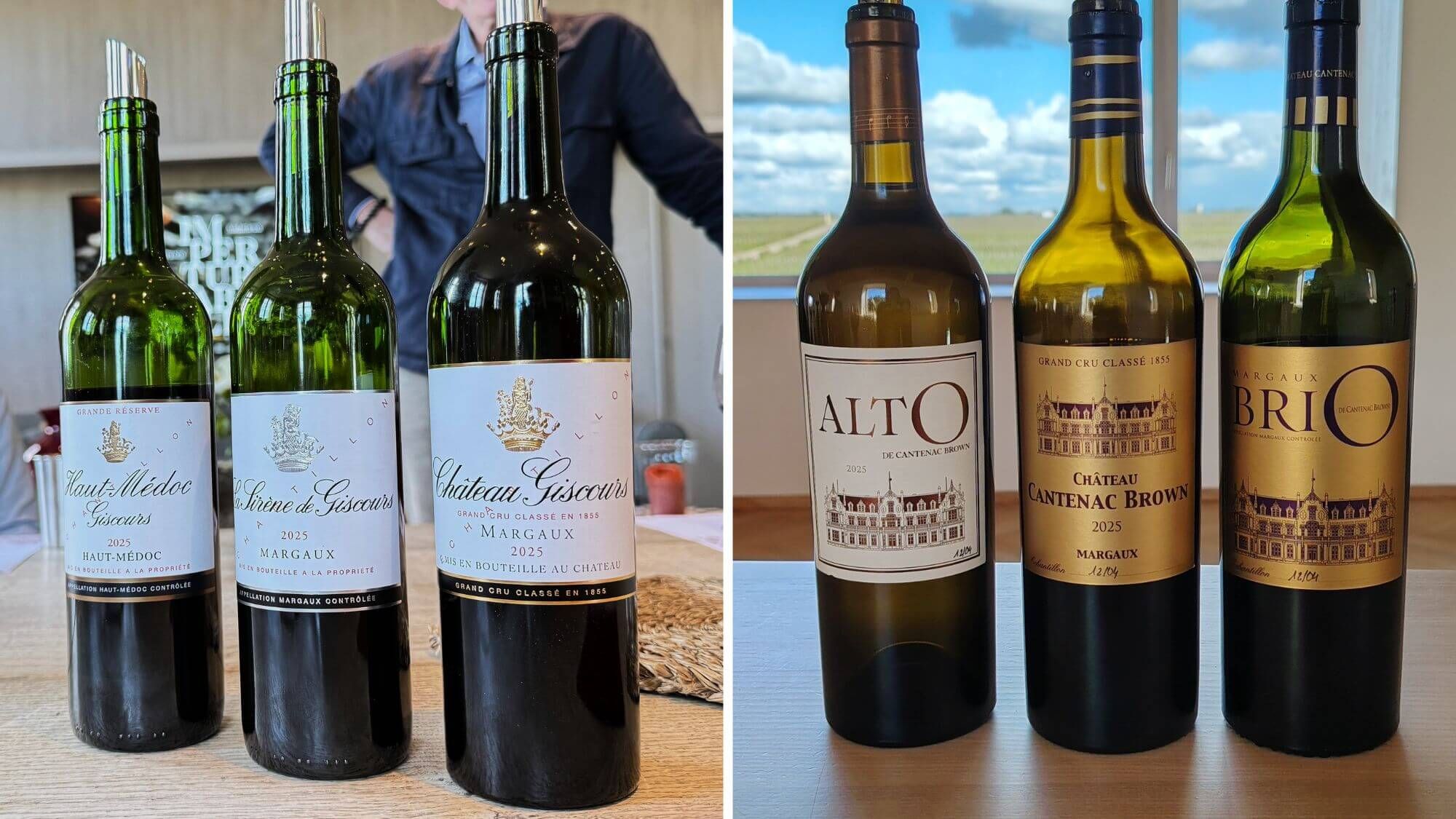
Many estates shine in this regard: Château Giscours, Château Canon La Gaffelière, Château Rocheyron, Château Cantenac Brown, Château Poujeaux, Château Larrivet Haut-Brion…
4. Remarkable Purity of Cabernet Sauvignon
Cabernet Sauvignon shows exceptional purity in 2025. In blends where it accounts for around 60%, it often feels closer to 80% in presence. Like a lead dancer commanding the stage, it shines through even within a group.
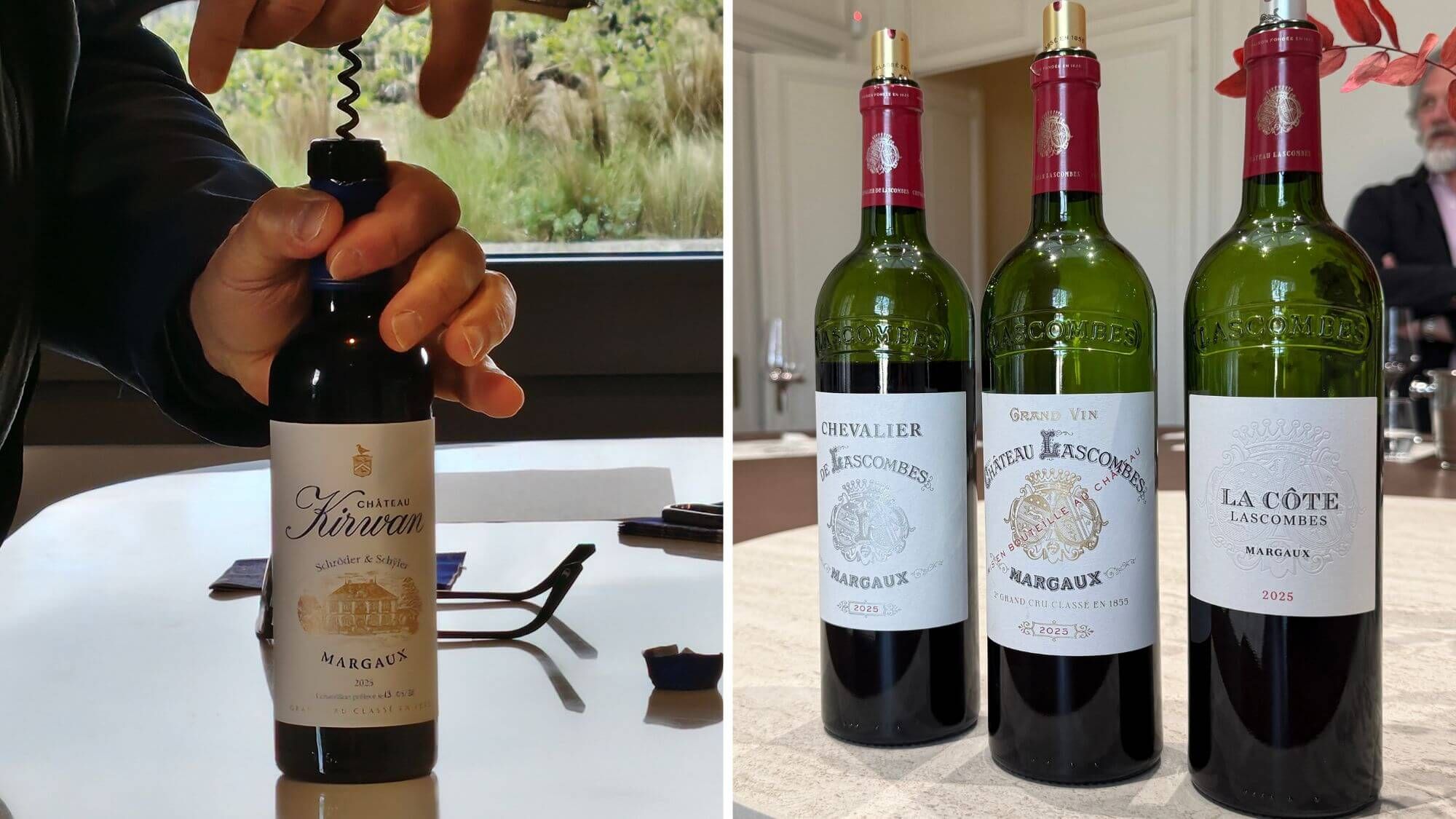
Estates such as Château Cos d’Estournel, Château Kirwan, Château d’Armailhac and Château Lascombes left a particularly strong impression. Notes of blackcurrant are vividly defined, while violet aromatics drift gently around them.
On the palate, the evolution is seamless and fluid: the entry is clear and juicy, with a gentle softness; through the mid-palate, structure and tension gradually unfold, moving from a sense of flow into a firm, steady finish. The entire progression feels natural and unforced.
5. Oak Nearly Imperceptible
In recent years, top Bordeaux estates have shown increasing precision in their use of oak. Yet in a vintage like 2025, where its presence is rendered almost imperceptible, such restraint is truly rare.
Among leading estates, I encountered virtually no instances where toasted oak notes overshadowed the fruit. Even in samples freshly drawn from barrel, a gentle swirl of the glass, or simply a moment of air, was enough for the floral and fruit aromatics to emerge naturally.
6. Enduring Aging Potential
This vintage brings together firm structure, a rich texture, pure aromatics, and a beautifully judged balance. Beyond these qualities, In addition, it holds a trump card for long-term aging: a relatively low pH. a relatively low pH. Acting as a natural safeguard, it lends the wines remarkable stability over time.
We have every reason to believe that the red wines of 2025 will not only show impressive aging potential but will also offer a constantly evolving experience, revealing new dimensions of beauty at every stage of their development.
White Wines
From a purely technical standpoint, the white wines of 2025 are, in fact, quite solid: alcohol, total acidity and pH all fall within a favourable range. Yet based on my overall tastings, this is not a vintage I would strongly recommend, and the issue lies primarily in the aromatic expression.
With generally high levels of ripeness, the profile tends to lean toward stone fruit and tropical notes. The wines are rounded and clean, but often lack the finesse and the sense of lift that white flowers and crisp citrus typically bring. Acidity is not low, but with relatively modest malic acid, the structure feels more horizontal than vertical. Toward the mid-palate and finish, a number of wines begin to hollow out, with structure gradually losing its support, raising some doubts about their aging potential.
In this vintage, harvest timing was particularly critical. Sémillon, if harvested too late, can become overly broad, while Sauvignon Blanc may show elevated alcohol and a flattened aromatic profile. Without careful handling, the wines can feel loose and lacking tension, giving an impression of softness without structure.
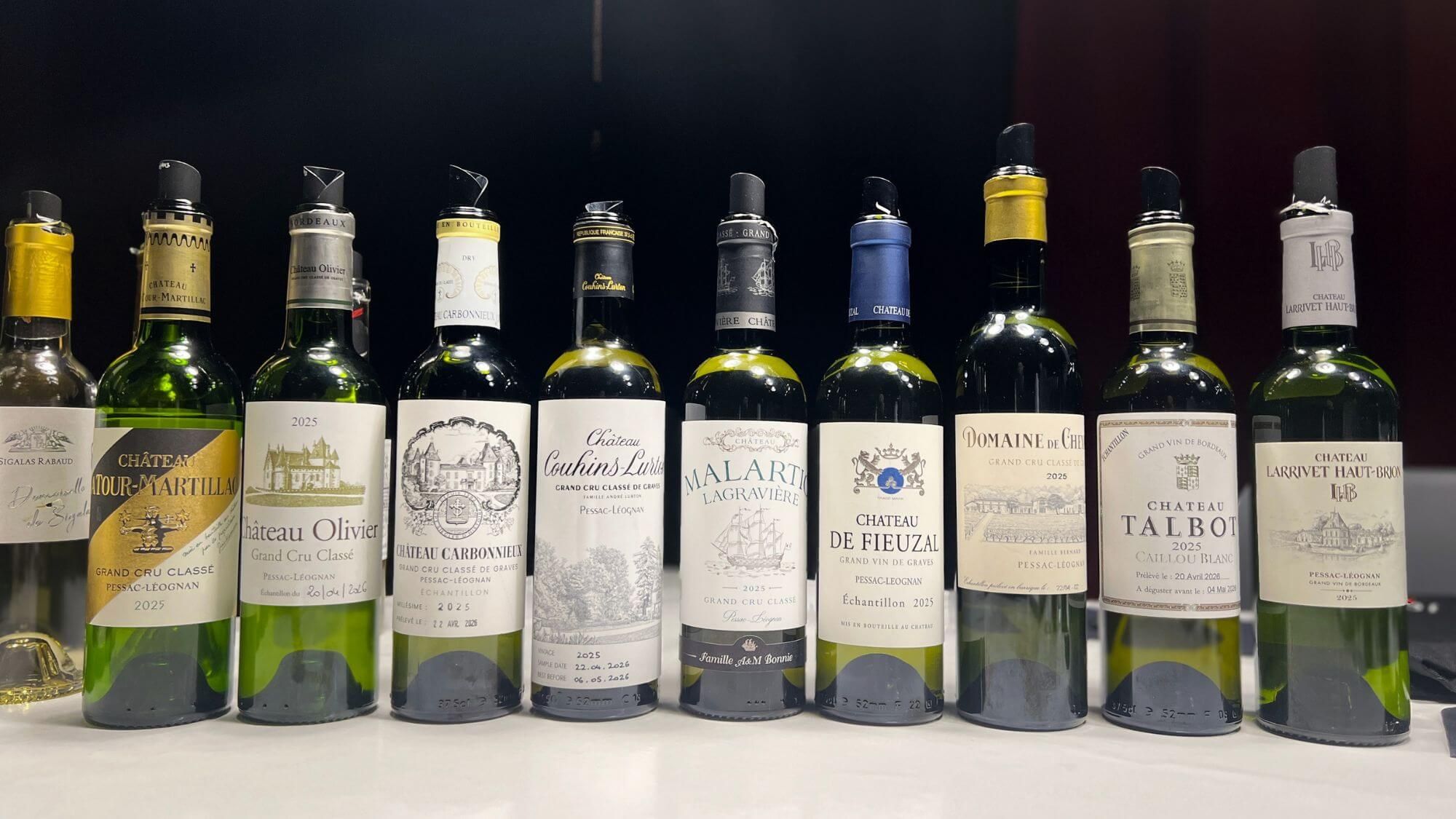
Of course, there are certainly some outstanding examples. Estates on limestone soils, as well as leading properties in Pessac-Léognan, performed especially well. While they show a certain generosity of fruit, they also possess bright, well-defined acidity, a tight, clearly structured frame, and a clean, precise finish, with an impressive overall sense of completeness.
Overall, the white wines of 2025 call for careful selection.
Recommended estates include:
Le Grand Village
Les Champs Libres
Château Plain-Point
Château Lamothe Bergeron (Cuvée Maxence)
Château La Louvière
Château Olivier
Château Latour-Martillac
Domaine de Chevalier
Château de Fieuzal
Château Couhins
Château Couhins-Lurton
Château Larrivet Haut-Brion
Château La Mission Haut-Brion
Noble Rot Sweet Wines
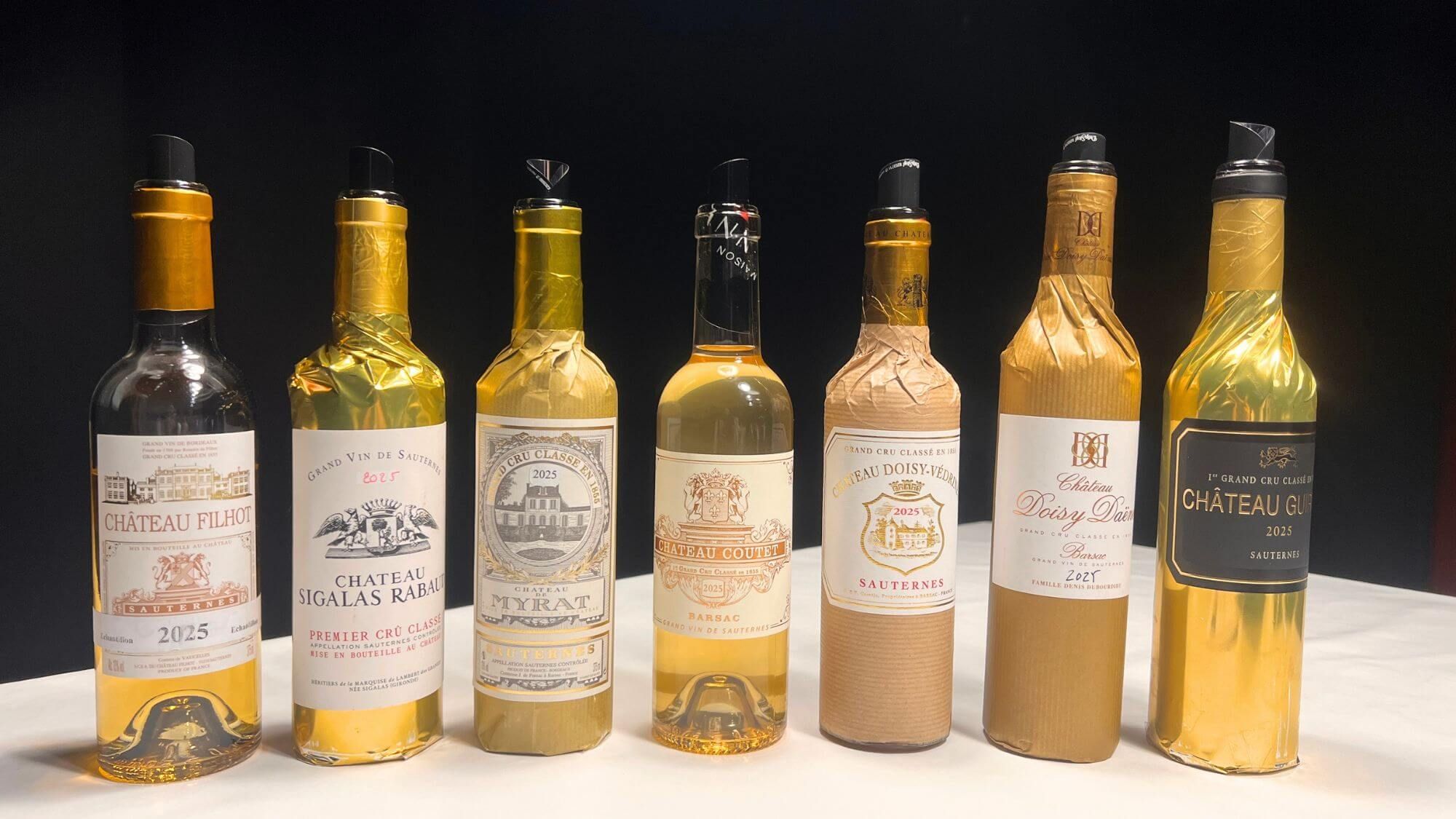
Regarding the noble rot wines, I have heard some concerns suggesting that sugar levels are too high and acidity insufficient, and that the overall quality is less than ideal. Having tasted them, however, I take a different view. In my opinion, 2025 is a vintage of notable quality for sweet wines.
When it comes to judging a botrytised wine, acidity is not the defining factor; what matters most is the purity of the noble rot. While acidity can be adjusted through picking decisions or winemaking, once botrytis is touched by unwanted microorganisms, it is like ink staining white cloth-the damage irreversible.
The September rains in 2025 effectively relieved the drought, allowing the already exceptionally healthy, small berries to enter the botrytisation phase at remarkable speed. The whole process unfolded very quickly, with almost no interference from unwanted microorganisms, and this was crucial.
For this reason, the noble rot wines of this year show an extremely high level of purity, with many displaying a full, deep golden colour. Aromatically, they are led by stone fruit and tropical fruit. They may not have the support of crisp citrus notes, but they still retain a fine sense of freshness.
On first tasting, the sweetness can feel almost overwhelming, as if you had plunged headfirst into a pond of honey. Yet if you take the time to look deeper, you will find that the acidity, spice and layered fruit are all there. They are simply wrapped for the moment in a high concentration of sugar, like little spirits sleeping in flower nectar, waiting for someone who understands them to set them free.
The best estates allow these layers to unfold gradually, with a finish marked by subtle spice, green Sichuan peppercorn and fresh ginger, carrying a gentle, tingling lift that lightly teases the palate. Wines that were less well handled, however, can easily fall into an overripe berry sweetness, becoming dull and heavy. Notably, quite a few noble rot wines show a refined saline-savoury touch on the finish, a quality that is particularly evocative in Château Doisy-Daëne, Château de Rayne Vigneau, and Château de Fargues.
One final reminder: because of their very high concentration and sugar levels, 2025 Sauternes must be served firmly chilled, ideally at 5–6°C. This cold serving temperature is the key to unlocking the many layers wrapped within these botrytised wines.
<Part IV>
Purchasing Tips
1. Tannin Texture as a Measure of Quality
The berries in 2025 are extremely small, even smaller than in 2022. Taking Cabernet Sauvignon as an example, 100 berries weigh less than 100 grams. This is very much a double-edged sword. A high volume of tannins can indeed give the wines impressive structure, but if extraction is even slightly misjudged, the result can quickly turn hard, blocky and drying.
In this context, the key lies in how these abundant tannins are handled. Those who are able to refine them into a fine, supple texture, allowing them to integrate seamlessly into every part of the wine, like warm beeswax melting into its fabric, will have a clear advantage in this vintage. For me, this is the single most important criterion when assessing quality in 2025.
Faced with such an abundance of tannin, I am more drawn to a winemaking philosophy of “working with the natural flow.” Rather than deliberately showcasing power, it resembles the practice of Tai Chi push hands, where intention guides force, allowing the sheer mass of tannins to move naturally through the wine. It may seem gentle on the surface, yet the direction is always firmly in hand.
A number of estates have handled this beautifully, including
Clos Saint Martin,
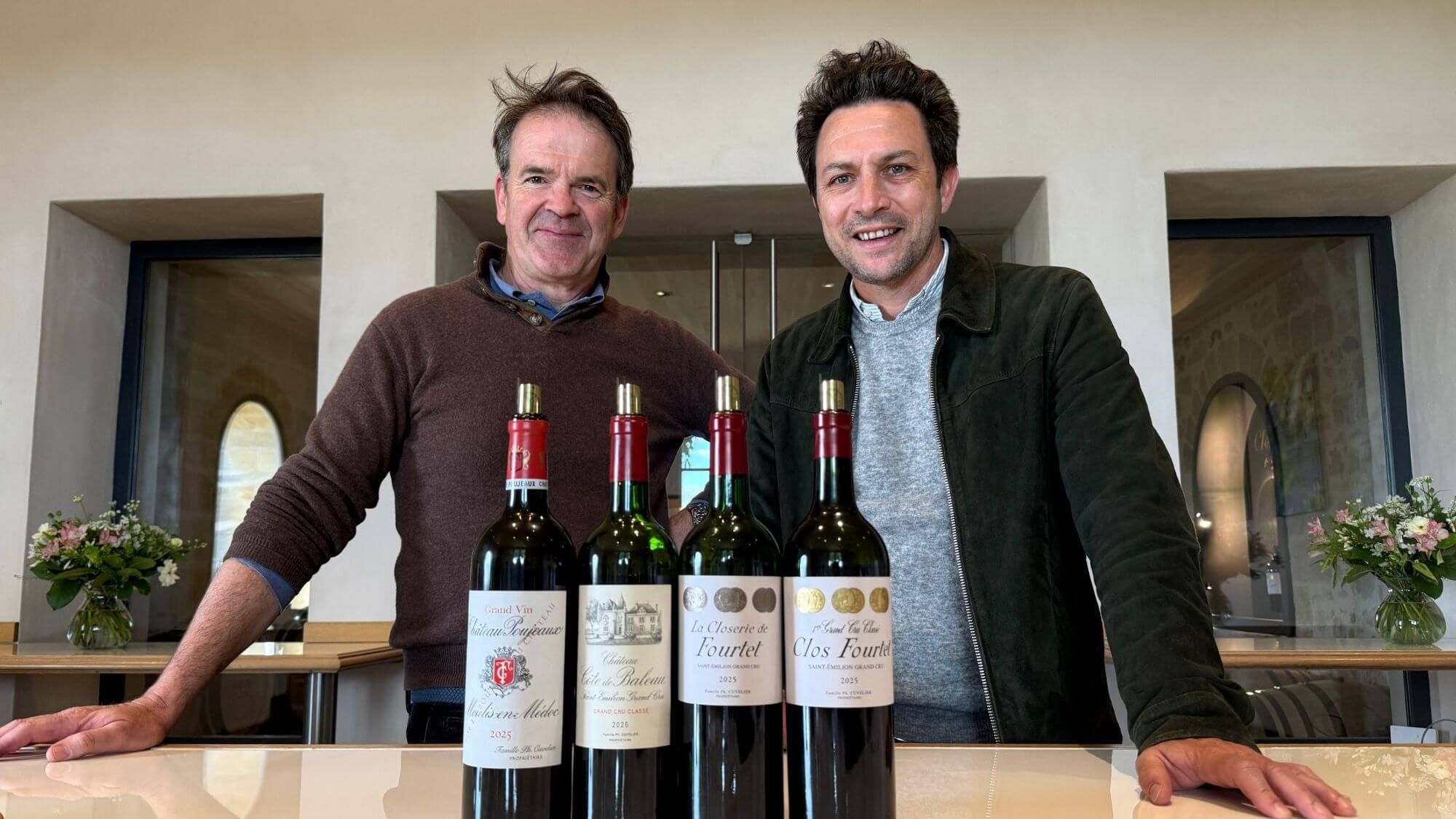
Clos Fourtet,
Château Larcis Ducasse,
Château Pavie Macquin,
Château Calon Ségur,
Château Montrose,
Château Pichon Baron,
Château Léoville Barton,
Château Haut-Bailly;
Château Smith Haut Lafitte.
2. Avoid Water-Stressed Terroirs
Quite a few people have mentioned that some 2025 wines come across as rather drying. This is true. While excessive extraction can be a contributing factor, a more important reason lies in the fact that the vines became so water-stressed during the growing season that they effectively stopped growing.
Sandy soils with low water retention are a good example. Under severe drought conditions, the vines enter a self-protective mode, slowing or even halting growth. At the same time, they begin to draw water back from the berries to survive. As a result, although the grapes appear concentrated at harvest, the phenolic compounds are not fully ripe. In the glass, this often translates into a coarse, forceful tannin profile, almost bulldozer-like in its impact.
This issue is particularly evident in Lalande-de-Pomerol, the western part of Saint-Émilion, and in early-ripening, shallow-soil sectors of Pomerol.
Extra caution is advised when selecting wines from these areas.
Several estates in these zones have delivered excellent results, including
Château Jean Faure,
Château Grand Corbin,
Château La Tour Figeac,
Château Figeac,
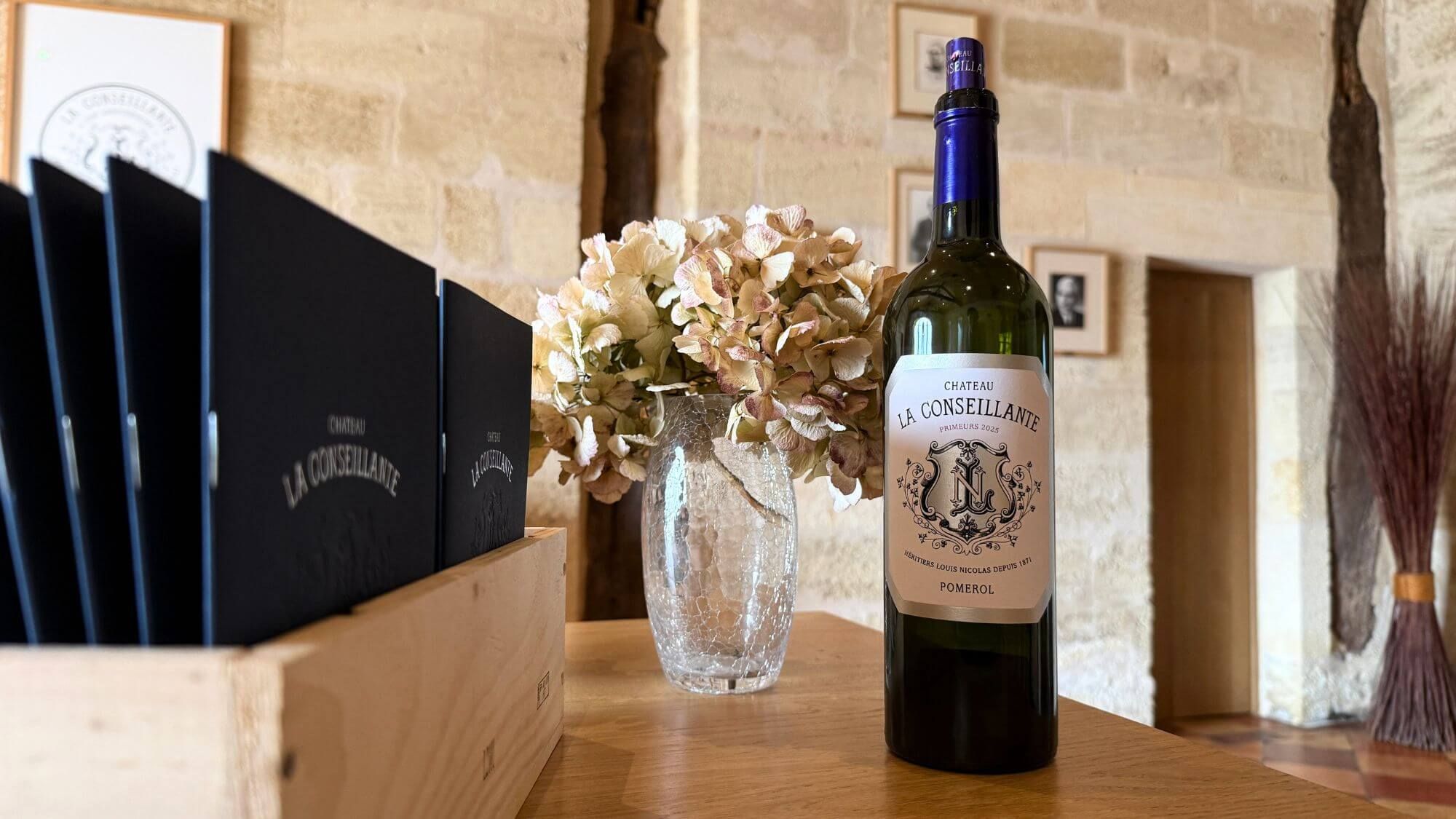
Château La Conseillante,
Château l’Évangile,
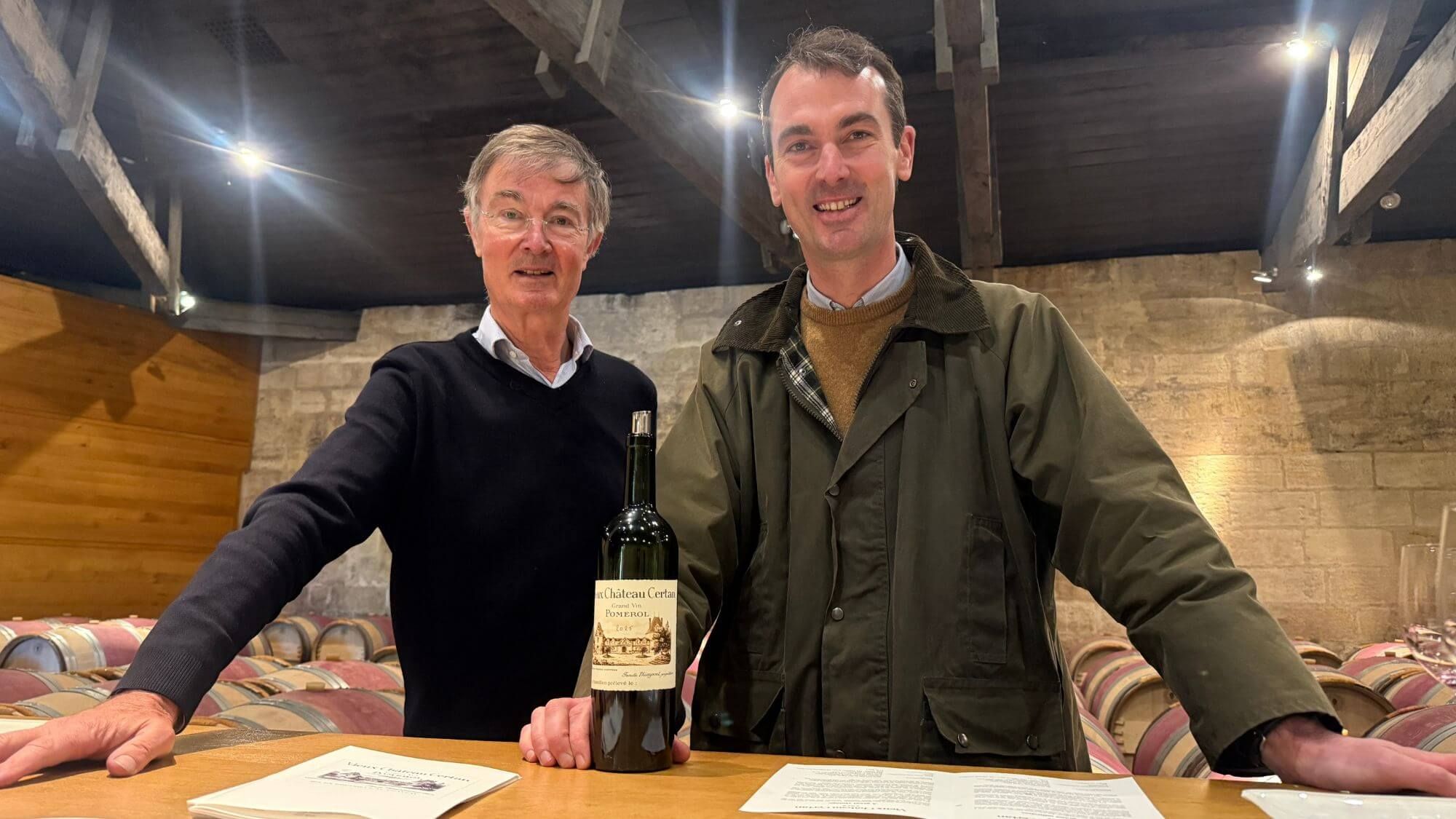
Vieux Château Certan.
3. A Sense of Envelopment: The Key to Poise in 2025
We know that the 2025 vintage is built on a grand structure. What it requires, therefore, is the right “material” and “substance” to fill it. If there were one simple way to describe this ideal state of harmony, it would be a sense of envelopment.
There are many paths to achieving this. It can come from a soft, supple texture that gently dissolve the structure, as in Château Rauzan-Ségla and Château La Mission Haut-Brion;
it can be shaped by the saline tension imparted by limestone soils, drawing the structure inward, as in Château Canon, Château Bélair-Monange and Château Bellevue;
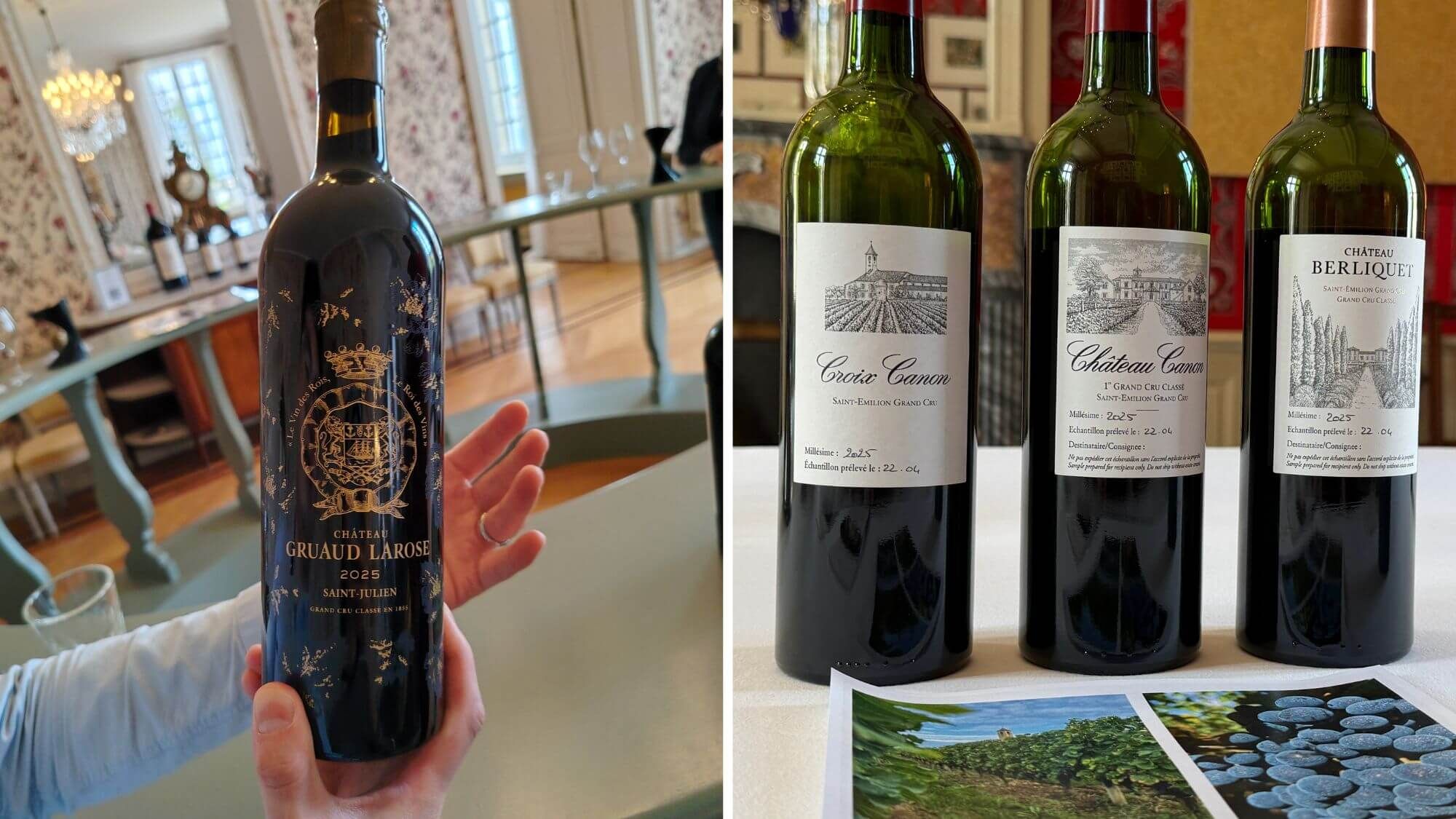
it can arise from vibrant juiciness that fills out the wine, as in Château Giscours, Château Gruaud Larose and Château Cantenac Brown;
or from the rounded texture brought by lees aging, softening the palate, as in Château Haut-Bailly, Château La Garde and Château Latour-Martillac.
Ultimately, once this sense of envelopment is in place, no matter how profound or powerful the wine may be, what it ultimately reveals is a sense of ease and quiet harmony.
4. Extra Caution Is Needed When Selecting Second Wines
As is well known, the grapes used for second wines at many top estates often come from younger vines or from “second-tier” parcels. In the intense heat and drought of the 2025 vintage, the adaptability of young vines has proven far from consistent, with results varying significantly.
A common issue is that the fruit has already moved into over-ripeness, while the tannins still carry a certain unripe, grainy texture. Unless the estate has been exceptionally strict in its selection, downgrading, or even discarding a significant portion of the crop, many second wines struggle to reach the level expected of a strong vintage.
I have selected several second wines that performed well during the En Primeur tastings and would recommend them here. However, their final quality will only be fully confirmed once the wines are bottled.
Frank Phélan
Pavillon de Léoville Poyferré
Alter Ego
Le Petit Lion
Chevalier de Lascombes
Les Griffons de Pichon Baron
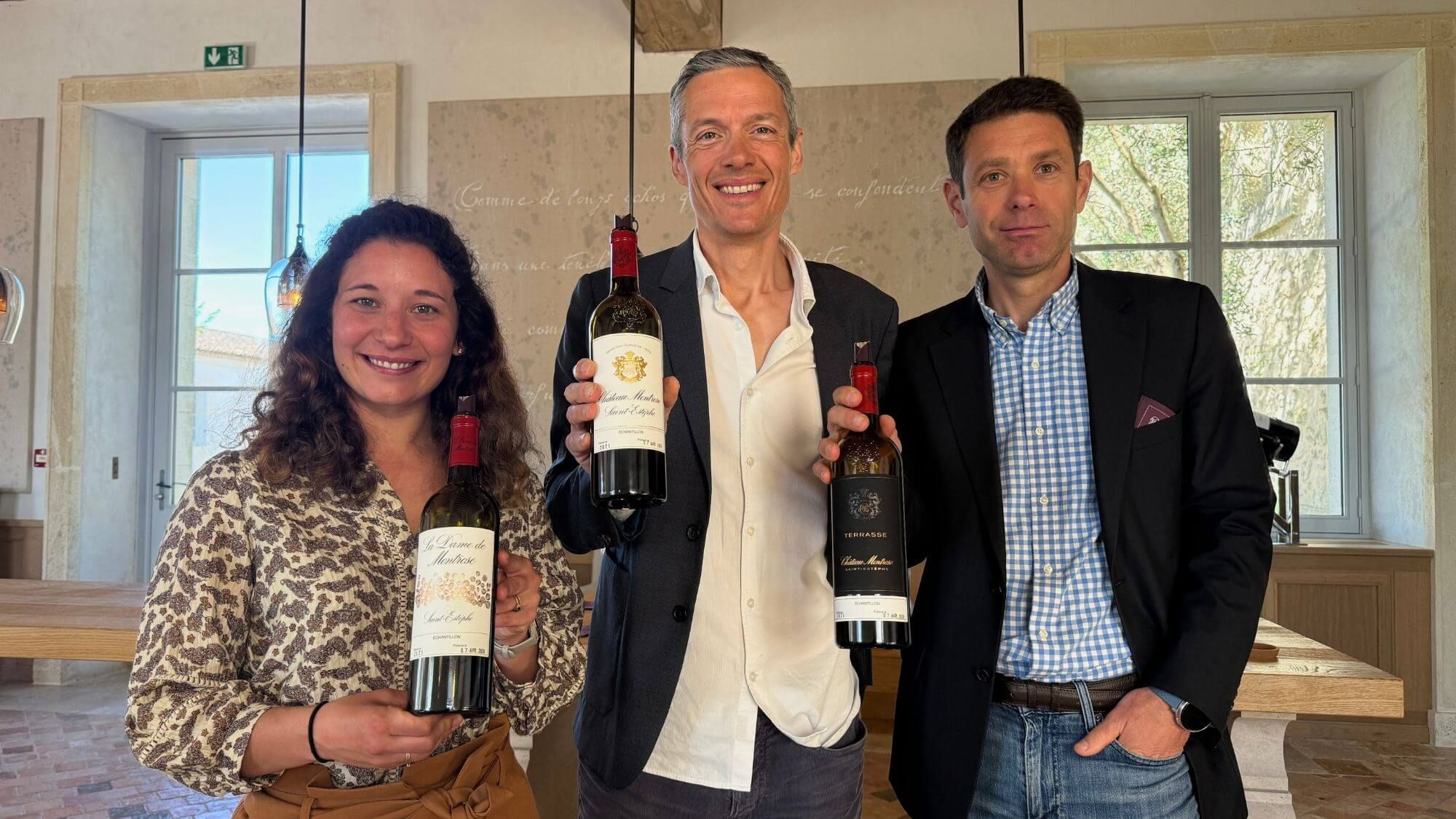
La Dame de Montrose
Carruades de Lafite
Ségla
Sarget de Gruaud Larose
Haut Bailly-II
La Chapelle de la Mission Haut-Brion
Le C des Carmes Haut-Brion
Le Petit Smith Haut Lafitte
La Closerie de Fourtet
Arômes de Pavie
Croix-Canon
Carillon d’Angélus
5. Seeking Volume? Look to Later-Ripening Terroirs
Later-ripening terroirs have generally enjoyed a relative yield advantage in 2025. Because of their later-ripening nature, these sites largely avoided the impact of low temperatures and rainfall during the flowering period in 2024, as seen in regions such as Saint-Estèphe, Fronsac, and Castillon. As a result, they tended to produce a higher number of bunches, with yields approaching or even exceeding 40 hl/ha in a number of cases.
Meanwhile, these terroirs often benefit from cooler microclimates. In a hot, dry and early-ripening vintage such as 2025, they are naturally less exposed to severe water stress than other areas. This has made them among the few zones in 2025 to achieve both strong quality and relatively generous yields.
<Part V>
Important considerations after bottling
Can that brightness of fruit and floral aromatics be preserved?
From what I have tasted so far, I feel very confident about how the 2025 vintage will show once bottled. If there is one point that merits attention, it is whether, over time, this vivid expression of fruit and floral aromatics can be preserved to its fullest extent.
After all, the wines will still undergo around a year of élevage in oak. While I have encountered virtually no signs of excessive oak influence at the En Primeur stage, the question remains: as the wines continue to evolve, will the emerging toasted notes integrate seamlessly with the vibrant fruit, rather than dimming its brightness? This is something I will be watching closely when tasting the wines in bottle.
<Part VI>
A Closing Reflection
As I was writing this report, Château Pontet-Canet released its 2025 En Primeur at a price below that of the 2024 vintage. This is undoubtedly a positive signal, and it reflects a more pragmatic approach to pricing in Bordeaux.
For consumers, the fundamental logic behind buying En Primeur lies in the conviction of future value, and in the validation of one’s own judgment and foresight. It is my hope that the 2025 Bordeaux En Primeur campaign will once again demonstrate the true value of this system, offering not only financial return, but also a reward across time for those with patience and vision.
To conclude, I would like to sum up the 2025 Bordeaux vintage in a single line:
A crystal, kissed by the sun.
The searing summer did not melt it; instead, it endowed it with an extraordinary purity and a structure of striking clarity.
Each aroma passes through like a beam of light;
each fruit note refracted into sharp definition.
What is etched into it are the memories of drought and heat;
what unfolds on the palate, however, is a remarkable sense of transparency and vitality.
This is the story Bordeaux tells us in 2025:
a meditation on loss and gain,
a journey of refinement through fire,
and a wine destined to become a timeless classic.
<Part VII>
AMA En Primeur Selection –
“Blooming Lotus Selection” 2025
<Symbolic Definition>: The term “Xin Shui 心水”, which signifies “my favorite”, was employed by ancient Chinese sages to describe an insightful philosophy of life: keeping a heart as serene as a tranquil water surface. Only by engaging in devoted refinement and staying true to one’s original faith can we inch closer to the realm of perfection. Blooming lotus emerges gracefully from water, a perfect expression of the essence of purity and inner serenity.
<Blooming Lotus Selection>: En Primeur wines that deliver distinct quality, and present an adequate interpretation of their unique terroir, all while offering exceptional value. As vibrant embodiments of Bordeaux’s enchanting beauty and its “original aspiration”, they merit wider recognition and appreciation.
| AMA En Primeur Selection – “Blooming Lotus Selection” 2025 Left Bank |
|||
| Wine | Colour | Vintage | AMA Score |
| Château Montrose | Red | 2025 | 99-100 |
| Château Lafite Rothschild | Red | 2025 | 99-100 |
| Château Haut-Brion | Red | 2025 | 99-100 |
| Château Pontet-Canet | Red | 2025 | 98-99 |
| Château Rauzan-Ségla | Red | 2025 | 97-99 |
| Château Calon Ségur | Red | 2025 | 97-98 |
| Château Giscours | Red | 2025 | 96-98 |
| Château Brane-Cantenac | Red | 2025 | 96-98 |
| Château Léoville Barton | Red | 2025 | 96-98 |
| Château Gruaud Larose | Red | 2025 | 96-98 |
| Château Léoville Poyferré | Red | 2025 | 96-97 |
| Château Durfort-Vivens | Red | 2025 | 96-97 |
| Domaine de Chevalier | Red | 2025 | 96-97 |
| Château Clerc Milon | Red | 2025 | 95-97 |
| Château Lascombes | Red | 2025 | 95-97 |
| Château Phélan Ségur | Red | 2025 | 95-97 |
| Château Cantenac Brown | Red | 2025 | 95-97 |
| Château Malartic-Lagravière | Red | 2025 | 95-96 |
| Château Lafon-Rochet | Red | 2025 | 94-96 |
| Château Kirwan | Red | 2025 | 94-96 |
| Château Branaire-Ducru | Red | 2025 | 94-96 |
| Château Talbot | Red | 2025 | 94-96 |
| Château Larrivet Haut-Brion | Red | 2025 | 94-96 |
| Château Latour-Martillac | Red | 2025 | 94-96 |
| Clos du Marquis | Red | 2025 | 94-96 |
| Château Meyney | Red | 2025 | 94-95 |
| Château Carbonnieux | Red | 2025 | 94-95 |
| Château Siran | Red | 2025 | 94-95 |
| Château Fourcas Hosten | Red | 2025 | 93-95 |
| Château Potensac | Red | 2025 | 93-95 |
| Château Poujeaux | Red | 2025 | 93-95 |
| Château Olivier | Red | 2025 | 93-95 |
| Château Cantemerle | Red | 2025 | 93-95 |
| Château La Louvière | Red | 2025 | 93-94 |
| AMA En Primeur Selection – “Blooming Lotus Selection” 2025 Right Bank |
|||
| Wine | Colour | Vintage | AMA Score |
| Château Ausone | Red | 2025 | 99-100 |
| Château Canon | Red | 2025 | 99-100 |
| Château La Conseillante | Red | 2025 | 98-100 |
| Château l’Évangile | Red | 2025 | 98-99 |
| Château Pavie | Red | 2025 | 97-99 |
| Château Belair-Monange | Red | 2025 | 97-99 |
| Clos Fourtet | Red | 2025 | 97-99 |
| Clos Saint Martin | Red | 2025 | 97-98 |
| Château Larcis Ducasse | Red | 2025 | 97-98 |
| Château Pavie Macquin | Red | 2025 | 97-98 |
| Vieux Château Certan | Red | 2025 | 97-98 |
| Château Bellevue | Red | 2025 | 95-97 |
| Château Villemaurine | Red | 2025 | 95-96 |
| Château Clos de Sarpe | Red | 2025 | 95-96 |
| Château de Ferrand | Red | 2025 | 95-96 |
| Château Fonroque | Red | 2025 | 95-96 |
| Château Canon La Gaffelière | Red | 2025 | 95-96 |
| Château La Clotte | Red | 2025 | 95-96 |
| Château Rocheyron | Red | 2025 | 95-96 |
| Château Laroque | Red | 2025 | 94-96 |
| Château Tour Saint Christophe | Red | 2025 | 94-96 |
| Château de Pressac | Red | 2025 | 94-96 |
| Château Berliquet | Red | 2025 | 94-96 |
| Château Jean Faure | Red | 2025 | 94-96 |
| Château Pavie I Arômes de Pavie | Red | 2025 | 94-96 |
| Château La Tour Figeac | Red | 2025 | 94-95 |
| Château Grand Mayne | Red | 2025 | 94-95 |
| Château La Serre | Red | 2025 | 94-95 |
| Château Fonplégade | Red | 2025 | 94-95 |
| Château Fleur Cardinale | Red | 2025 | 93-95 |
| Château de La Dauphine | Red | 2025 | 93-95 |
| Clos Puy Arnaud | Red | 2025 | 93-94 |
| Château Tournefeuille | Red | 2025 | 93-94 |
| Château Grand Corbin | Red | 2025 | 92-94 |
| Château Alcée | Red | 2025 | 92-94 |
| Château La Prade | Red | 2025 | 92-94 |